
Credit card interest is the cost of borrowing when you do not pay your full statement balance by the due date. It is calculated based on your card’s Annual Percentage Rate (APR) and outstanding balance, rather than as a flat fee. Understanding how interest charges, APR, billing cycles, and minimum payments work can help you avoid extra fees and reduce your overall credit card costs.
How Does Credit Card Interest Work?
Most US credit cards use the Average Daily Balance (ADB) method to calculate interest. Each day, your issuer records the amount you owe. At the end of the billing cycle 
 What is a billing cycle and How does it work? A Complete Beginner’s Guide, all daily balances are summed and averaged. The issuer then applies your daily APR to that average balance to determine how much interest you owe. Unlike installment loans with fixed monthly charges, credit cards use a revolving balance system, so you are charged only if you do not pay your full statement balance by the due date. The process works as follows:
The Annual Percentage Rate (APR) reflects your yearly borrowing cost, but credit card interest accrues daily. Issuers divide the APR by 365 to determine the daily periodic rate, which sets the daily charges on your balance.
Example: A 24% APR ÷ 365 = 0.065% per day. While that number seems small, daily charges accumulate quickly over a full billing cycle.
Card issuers track your balance each day, not just at the end of the month, and every transaction, including purchases, payments, refunds, and fees, affects it. Making a large purchase early in the billing cycle results in a higher balance for a longer period, which may increase borrowing cost charges if you fail to pay the balance by the due date.
The daily periodic rate is multiplied by your average daily balance to calculate interest charges. Unpaid interest is added to your balance, and future borrowing cost is calculated on this higher amount. This process, known as compounding, can significantly increase the total amount you owe over time.
Most purchase interest charges can be avoided by paying your full statement balance by the due date. This maintains your grace period and typically prevents APR cost on new purchases.
What is APR on a Credit Card?
Annual Percentage Rate is the yearly cost of borrowing money on your credit card. Even though it’s shown as an annual rate, the charges are actually calculated daily. Your credit card’s APR affects how much it costs to carry a balance.
In the U.S., credit card APRs are generally higher than those of other loan types. As a result, credit cards are better suited to short-term expenses than to long-term borrowing. Most credit cards have more than one APR, and each one applies to different actions you take with your card.
Types of Credit Card Interest in the U.S.
| Transaction type | Category of use | APR range |
|---|---|---|
| Cash Advance | ATM withdrawals | 25%–35% |
| Penalty | Late payments | >29% |
| Balance Transfer | After promos end | 15%–29% |
| Purchase | Regular spending | 15%–29% |
| Intro | Promotional period | 0% |
Credit cards usually have multiple APRs, each linked to a specific transaction type. Knowing these rates can help you avoid surprise credit card charges and manage your account more effectively.
Cash Advance
The cash advance APR applies when you withdraw cash from an ATM or make a similar transaction with your credit card. This rate is typically the highest, often between 25% and 35%. Charges apply immediately, with no grace period, making cash advances one of the most expensive credit card transactions.
Penalty
A penalty APR may apply if you miss or make late payments. This rate can exceed 29% and may remain in effect for several months or longer, depending on the issuer’s terms. It significantly increases borrowing costs and makes it more difficult to pay down your balance.
Balance Transfer
The balance transfer APR applies after any promotional period ends. Many cards offer an introductory 0% APR on transferred balances for a limited time, but the standard rate usually ranges from 15% to 29%. If you do not pay off the balance during the promotional period, interest charges will accrue at the higher rate.
Purchase
The purchase APR applies to everyday credit card spending, such as shopping, dining, and paying bills. This rate typically ranges from 15% to 29%. Paying your full statement balance by the due date usually allows you to avoid interest charges due to the grace period.
Introductory
A temporary promotional rate, often 0%, is offered for a set period on purchases, balance transfers, or both. After the promotional period, the APR increases to the standard rate. Knowing the length of the introductory period helps you avoid unexpected interest charges.
Why is Credit Card Interest So Expensive?
Credit card interest rates are among the highest in consumer lending because these products are intended for short-term convenience rather than long-term borrowing. Carrying a balance from month to month can quickly become costly because of how credit cards are structured and priced.
- Credit Cards Are Unsecured Loans: Unlike mortgages or auto loans, credit cards do not require collateral. Lenders charge higher Annual Percentage Rates (APRs) to compensate for the increased risk of missed or defaulted payments.
- Convenience and Built-In Benefits Raise Costs: Credit cards offer instant access to funds, flexible repayment options, fraud protection, and rewards programs. While these features benefit cardholders, they also raise issuer costs, which are reflected in higher interest rates.
- Pricing Encourages Short-Term Use: Credit card pricing discourages carrying a balance. Paying your statement balance in full each month avoids credit card charges, while carrying a balance results in daily interest compounding. Late or missed payments
 What Happens if I Miss a Credit Card Payment? How to Avoid Long Term Damage may also trigger higher penalty APRs, making long-term borrowing particularly costly.
Finsery pro tip
 Why the Average American Overpays Hundreds in Credit Card Interest Every Year were charged roughly $160 billion in credit card interest — according to the CardRates
 Best Practical Ways to Avoid Credit Card Interest Charges
Avoiding credit card interest is a simple way to save money. Since interest accrues daily and APRs are high, even small balances can increase rapidly. Here are a few best practical ways:
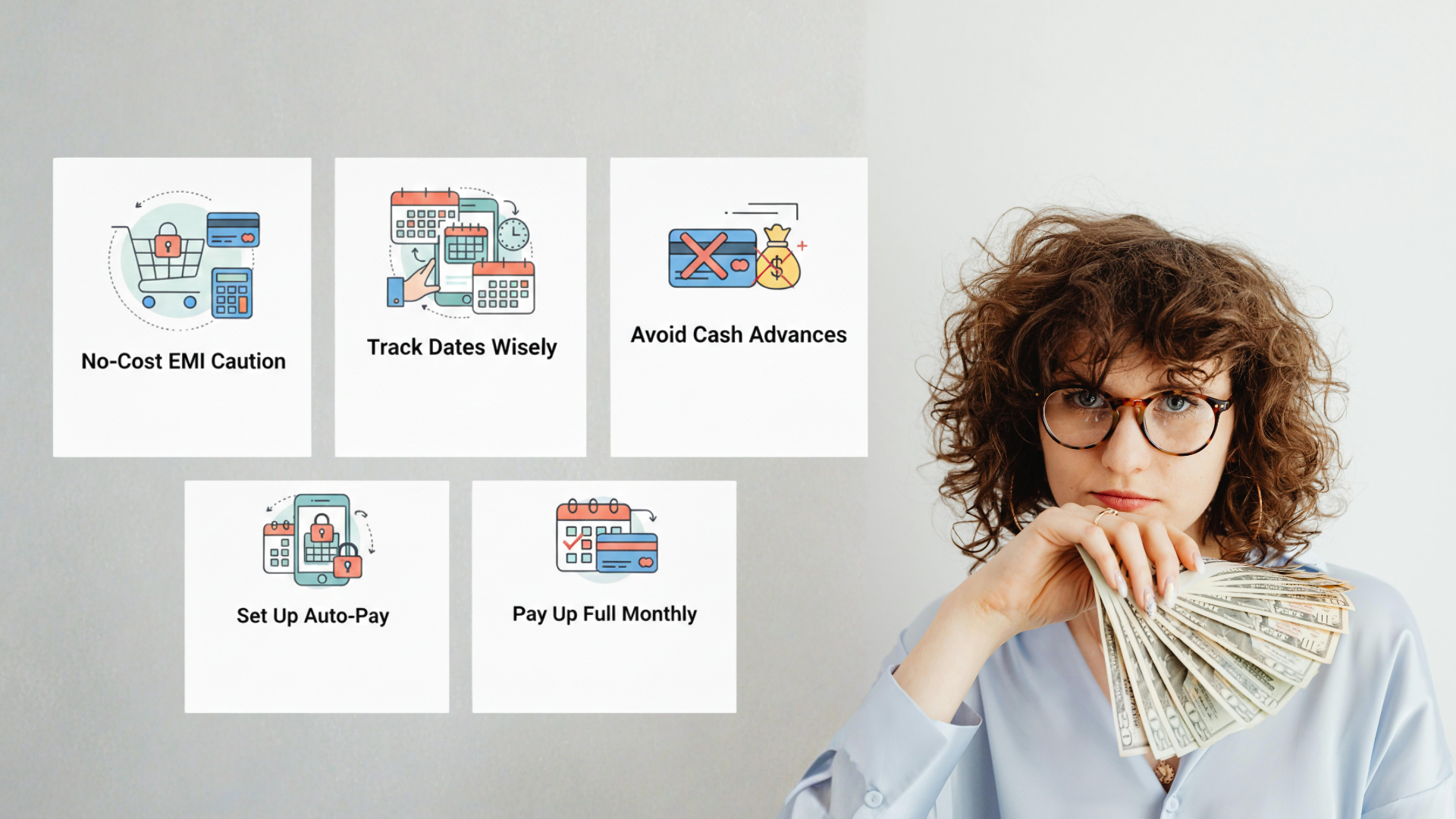
1. Be Cautious with No-Cost EMI Offers
No-cost EMIs may involve hidden charges, such as processing fees or increased product prices. Even if credit card charges are not initially disclosed, you could end up paying more overall. Review the total payment amount before choosing an EMI.
2. Avoid Credit Card Cash Advances
When you take a cash advance, interest starts accruing right away, and there is no grace period. Cash advances also tend to have higher APRs than regular purchases and additional fees. These extra costs make cash advances one of the most expensive ways to use your credit card.
3. Track Statement and Due Dates
The closing date on your statement is just as important as the payment due date when managing credit card charges. Purchases made right after your statement closes will be reflected in the next billing cycle, giving you extra time before payment is due. This timing can help you maximize your interest-free grace period, which is particularly beneficial for larger purchases.
4. Set Up Auto-Pay for the Full Statement Balance
Setting up auto-pay for your full statement balance helps you avoid missed payments and late fees. Your credit card bill will be paid on time every month, even if you forget the due date. Make sure to select the full balance option instead of just the minimum payment so you won’t incur extra charges.
5. Pay Your Full Statement Balance Every Month
If you pay your full statement balance by the due date, you keep your grace period and avoid interest charges. Even with a high APR, paying in full means you won’t owe any interest. This way, your credit card stays a convenient way to pay rather than an expensive way to borrow.
Frequently Asked Questions
Back to topYes, Paying only the minimum due keeps your account in good standing and helps you avoid late fees, but it does not stop interest from being charged. Any unpaid portion of your statement balance continues to accrue, often on a daily basis. In many cases, you may also lose your grace period.
No, credit cards don’t always charge interest every month. You only pay the charges if you carry a balance after the grace period. If you pay your full statement balance by the due date, you won’t get charged any interest.
Carrying a balance does not help your credit score and will only lead to interest charges. In some cases, your credit score might even go down. It is better to pay your balance in full.
Yes, balance transfers can have interest; it depends on the offer. Many credit cards provide a 0% introductory APR on balance transfers for a limited promotional period. During that time, you won’t pay interest on the transferred amount. However, Some balance transfer offers may also include a transfer fee, typically a percentage of the amount moved, which adds to the overall cost.
Usually, credit card interest cannot be taken off. Some companies might give a one-time waiver if you have a good payment record or if there was a mistake, but this does not happen often. The best way to avoid interest is to pay your full balance on time.
