

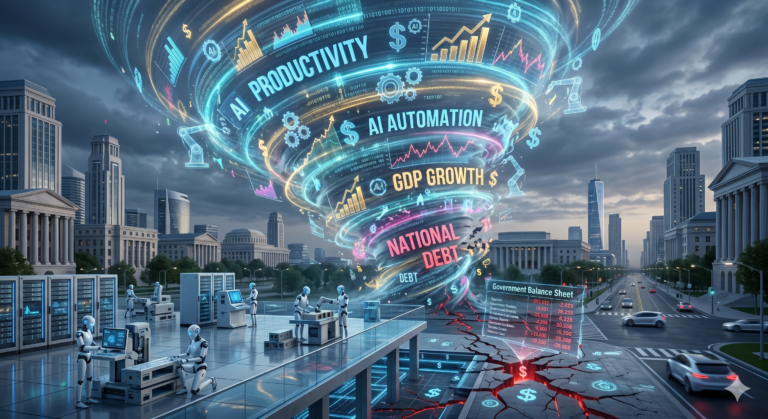
Artificial intelligence is rapidly reshaping the U.S. economy, increasing productivity across industries from banking to manufacturing. As policymakers search for ways to manage America’s rising national debt, some economists believe AI-driven economic growth could help improve government revenues, reduce fiscal pressure, and reshape the country’s long-term financial outlook.
Can AI Productivity Reduce the National Debt Burden?
The debt of the nation, as measured by its debt-to-GDP ratio, has risen substantially in the last twenty years due to continued budget deficits, high interest payments, and growing expenditure by the government. Although classic ways of dealing with such problems, such as cutting down expenditures and increasing taxes, continue to be difficult due to political reasons, a new method for solving the problem has arisen as a result of technological innovation: productivity through artificial intelligence (AI). The Yale Budget Lab states that improved productivity brought about by AI can increase annual GDP growth by 1.5% to 2%.
If the country’s economy is enhanced through the use of AI in terms of efficiency, then the country’s debt/GDP level will be decreased. As an illustration, JPMorgan Chase has used AI technology in the process of detecting fraud and lending. As a result, the cost savings are 20%, which will be accelerated in the provision of services. The positive impact on profit, salaries, and expenditure of consumers will lead to more revenue collection from taxpayers.
How AI Enhances Labor and Capital Efficiency
AI tools are making workers more productive by automating repetitive tasks and supporting faster decision-making. Businesses that deploy machine learning models for supply chain forecasting, customer service chatbots, or automated accounting see measurable efficiency improvements. These advancements allow companies to do more with fewer resources, enhancing profitability and competitiveness.
- AI-powered predictive maintenance in manufacturing reduces equipment downtime by up to 50%, according to General Electric.
- Walmart uses AI algorithms to optimize inventory levels, reducing overstock and out-of-stock incidents by 30%.
- Natural language processing speeds up legal document review, saving law firms hundreds of billable hours annually.
- AI-driven energy management systems in commercial buildings cut utility costs by 15 to 25%.
- Automated underwriting in mortgage lending has reduced processing times from weeks to days.
Could AI Offset Rising Interest Payments on the Debt?
One of the most pressing concerns about the national debt is the growing cost of interest payments, which surpassed $890 billion in 2023. Higher interest rates have increased borrowing costs, diverting funds from public investments to debt service. However, AI-driven productivity gains could help offset these pressures by increasing nominal GDP growth, thereby making interest expenses a smaller share of the economy.
If AI leads to sustained productivity growth, the Federal Reserve may not need to maintain high interest rates for as long, especially if inflation remains under control. A study published by Range.com suggests that by 2027, AI adoption across healthcare, logistics, and financial services could add $4.5 trillion to U.S. GDP. That kind of growth would improve the government’s fiscal position significantly. For instance, UnitedHealthcare uses AI to streamline claims processing, saving an estimated $1.2 billion annually, which could be mirrored across public and private sectors alike.
Barriers to Realizing AI’s Debt-Reducing Potential
Despite its promise, AI’s impact on the national debt depends on widespread adoption, equitable access, and sound policy frameworks. Smaller businesses and rural communities often lack the infrastructure or expertise to implement AI effectively. Additionally, workforce displacement due to automation could temporarily increase government spending on unemployment benefits and retraining programs.
Key Challenges to Consider
- Uneven AI access between large corporations and small businesses may deepen economic inequality.
- Workforce transitions require significant investment in education and vocational training.
- Data privacy concerns and regulatory uncertainty could slow AI deployment.
- Initial AI implementation costs remain high for many public agencies.
- Overreliance on AI systems without human oversight risks operational failures.
What Role Can Policy Play in Leveraging AI for Fiscal Stability?
However, in order to exploit the full potential of artificial intelligence as far as tackling the debt issue is concerned, public policies will need to be implemented. The federal government can play an important role by providing incentives for AI-related studies and modernizing the public sector in general. In addition, it is necessary for lawmakers to design tax policies that will allow them to reap the benefits of AI-driven businesses and use them to reduce the deficit.
According to economic experts and policy analysts, proactive measures taken in terms of building up digital infrastructures and establishing AI standards will prove very helpful in the future. Equally important is broadening broadband networks and implementing AI programs at community colleges, which have already been successfully done in Ohio and Colorado.
While AI is unlikely to solve America’s debt challenges on its own, its potential to accelerate productivity and economic growth could become an increasingly important part of the fiscal conversation. The long-term impact will depend not only on technological innovation but also on how effectively governments, businesses, and workers adapt to the changing economy.
Frequently Asked Questions
Back to topArtificial intelligence could help reduce pressure on the national debt by improving productivity, increasing business efficiency, and boosting economic growth. A stronger economy may generate higher tax revenues without increasing tax rates, which could help narrow budget deficits over time.
Many economists believe AI adoption could significantly increase U.S. GDP growth over the next decade. AI technologies may improve efficiency across industries including healthcare, finance, manufacturing, and logistics, potentially accelerating overall economic output.
AI is expected to automate some repetitive tasks, but it may also create new jobs in technology, data analysis, cybersecurity, and AI management. Experts say workforce retraining and education programs will be important during the transition.
Higher productivity growth can strengthen the economy by increasing wages, business profits, and consumer spending. This may lead to higher government tax revenue and improve the debt-to-GDP ratio over time.