
Credit cards are powerful tools they offer rewards, protection, and convenience, but they can also trap you in expensive debt. In the U.S., consumers held over $1 trillion in credit card debt in the third quarter of 2023. Scripps News, citing FDIC data Average card interest rates are around 19.25% as of September 2026. Average Credit Card Interest Rates
At 20%, carrying just $1,000 costs $200 per year in interest. The good news is that credit card debt is almost always avoidable. This guide outlines a repeatable system for spending, paying, and protecting your credit so you can use cards safely and avoid debt.
How Credit Card Debt Happens
A credit card is a revolving loan. When you use your card, the issuer pays for the purchase. You owe that amount back later. If you do not pay the statement balance by the due date, interest can be charged on the remaining balance. For example, if you carry a $500 balance at a 20% APR, a simple calculation puts the interest at $8 per month. Over time, these charges can add up and cause you to pay significantly more than the original amount you spent.
Your credit card statement shows details, including your new balance, minimum payment, available credit, and payment due date. According to CFPB , if you pay the new balance of your credit card by the payment due date, you generally avoid interest during the card’s grace period. However, if you do not pay the new balance, you may lose that grace period and begin accruing interest even on new purchases depending on your card’s terms. The simplest way to avoid this cycle is to treat your credit card as a payment tool rather than extra money: only charge what you already have the money to pay for and aim to pay the full statement balance on time and in full.
5-Step Debt-Free Card Routine
To stay out of credit card debt, create a simple monthly system that you can repeat every month, even if you use more than one credit card. The goal is to make sure every purchase is already accounted for before you make it, the money to pay for your purchases stays available, and your statement balance is paid in full when it is due.
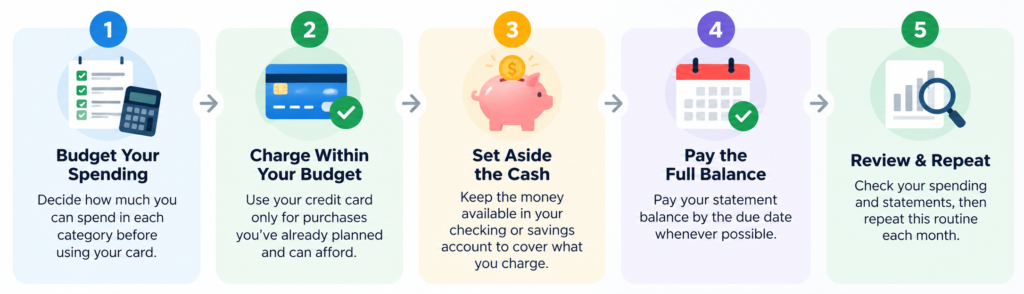
- Budget Your Spending: Before using your credit card, decide how much you can spend in each category based on your monthly budget. For example, you might set aside $300 for groceries, $100 for gas, and $150 for utilities. These amounts become your spending limits for the month, similar to keeping cash in separate envelopes.
- Charge Within Your Budget: Use your credit card only for expenses you’ve already planned and can afford. When you spend $50 on groceries, mentally treat that $50 as already spent rather than money that is still available. This helps prevent your credit card balance from growing beyond what you can comfortably repay.
- Set Aside the Cash: As you make credit card purchases, keep the money needed to pay for them in your checking or savings account. For example, if you’ve charged $50 for groceries and $40 for gas, you should have that $90 available for your eventual credit card payment. This way, your card balance is backed by money you already have.
- Pay the Full Balance: When your statement arrives, use the money you’ve set aside to pay the full statement balance by the due date. Paying the balance in full helps prevent your planned purchases from turning into revolving debt and allows you to use the card without continuously carrying a balance.
- Review and Repeat: After making your payment, review your statement and check that the transactions are correct. Look for purchases you don’t recognize, unexpected charges, or spending categories where you went over budget. Use what you learn to adjust your spending plan for the next month.
Following this cycle consistently makes credit card management more predictable. Instead of waiting for the bill to arrive and then figuring out how to pay it, you plan for the purchases first, keep the money available, and use your credit card as a payment tool rather than as extra spending money.
Practical Strategies to Manage Credit Cards Without Debt
Managing credit cards without getting into debt is about creating easy habits when it comes to spending, paying, and using credit. The main idea is to make sure that the things you buy fit into your budget, the amount you owe stays easy to handle, and you always pay on time. If you think of your credit card as a way to pay, not as money, you can build a daily routine that helps you avoid extra costs and keeps your money situation in check.
Aim to pay your full statement balance by the due date instead of relying only on the minimum payment. According to the CFPB , paying only the minimum can leave a balance that continues to accrue interest and may take much longer to repay. If you cannot pay the full balance one month, paying more than the minimum can help reduce the remaining balance and interest costs.
Decide how much you can safely spend before making credit card purchases. Set limits for categories such as groceries, gas, utilities, and entertainment, then track each purchase against those limits. This helps ensure that the money needed to pay your credit card bill is already accounted for in your budget.
Credit utilization is the percentage of your available credit that you’re using. For example, a $400 balance on a $1,000 limit represents 40% utilization. Keeping utilization below 30% is a commonly used guideline. U.S. Bank — How to Use Your Credit Card Wisely The source material also notes that some experts recommend keeping utilization closer to 10%–20%. Paying down a balance before the statement closes can also lower the utilization reported for that cycle.
One way to keep utilization lower is to pay down your balance before the statement closes. You can also consider requesting a higher credit limit if appropriate, while making sure the increase does not encourage additional spending.
Set up autopay for at least the minimum payment so you have a backup against missed due dates. If your budget and account balance allow it, you can automate the full statement balance instead. Calendar reminders and payment alerts can provide another layer of protection, especially when managing multiple cards with different due dates.
Regularly review your credit card transactions and statements to make sure your spending remains within your budget and to identify any unfamiliar charges. Transaction alerts can help you monitor purchases throughout the month, while reviewing your statement gives you an opportunity to check your balance, payment information, and spending before the next billing cycle.
How to Manage Multiple Credit Cards Without Going Into Debt
Having multiple credit cards can be useful when each card has a clear purpose. The key is to keep your spending organized and make sure you can manage every balance and payment.
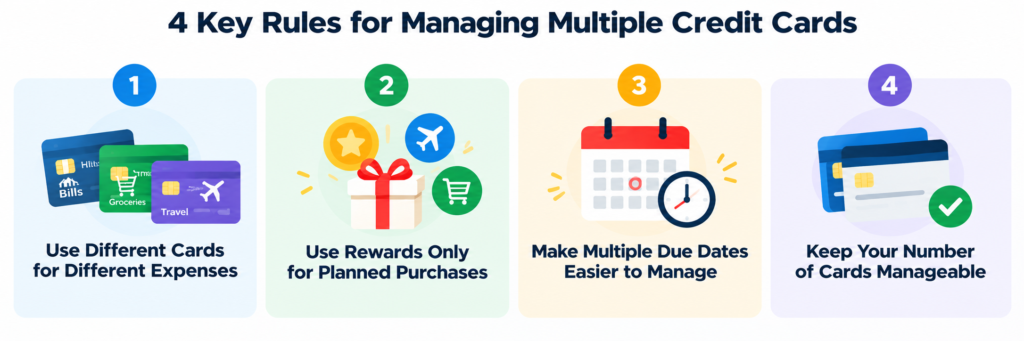
Use Different Cards for Different Expenses
One card can be used for monthly bills, such as utilities, phone bills, or insurance, works well. Then use another card for expenses, like groceries, gas, and dining. Fixed expenses are easier to plan for because you know what they will cost each month. Variable spending requires monitoring. No matter which card you use, keep each purchase within your budget. Plan to pay the balance in full.
Use Rewards Only for Planned Purchases
If one of your cards gives you cash, miles or other things you can get back use those things only for things you were going to buy anyway. For example, a card that gives you travel rewards might be good for a hotel booking if you already have the money to pay for it. The rewards should never be the reason you spend more than you can afford. Paying the amount every time is how you make sure the rewards are not canceled out by the interest you have to pay.
Make Multiple Due Dates Easier to Manage
Using cards means you have to keep track of multiple payment due dates. If your card issuers let you change your payment date, think about setting them together. That way you can handle all your payments at once each month. For example, having all your cards around at the same time makes it easier to remember when to pay. It also helps make sure you have money in your account when the payments come due.
Keep Your Number of Cards Manageable
There is no one number of credit cards that works for everyone. The main thing to think about is whether you can be sure you are keeping track of your spending, the amounts you owe, and the dates you need to pay. The information says that one or two cards might be better for people who want to stay out of debt. Having more cards can make your money matters more complicated. If you have cards, only use them when you can handle each one and keep paying what you owe as you planned.
Understand Your Credit Card Statement and Terms
Your credit card statement gives you the information you need to understand what you owe, when your payment is due, and what could happen if you don’t pay on time. Reviewing these details each month can help you avoid missed payments, unexpected fees, and unnecessary interest. For more information, see the CFPB’s credit card statement requirements .
| Statement Section | What It Tells You |
|---|---|
| Summary of Account Activity | Shows your transactions and provides details such as your new balance, previous balance, payments, and credits. |
| Payment Information | Shows your total new balance, minimum payment due, and payment due date. The statement also explains when a payment is considered on time. |
| Minimum Payment Warning | Shows how long it could take to pay off your balance if you make only the minimum payments and how much you could pay over that period. This helps demonstrate why paying more than the minimum can be important. |
| Late Payment Warning | Explains potential fees and the possibility of a higher APR if your payment is late. Your issuer may also apply a penalty interest rate under the terms of your account and must provide the required notice before certain rate increases. |
Make it a habit to review these sections whenever your statement arrives. Knowing what you owe, when your payment is due, and what your account terms mean can help you stay organized and avoid unnecessary credit card costs.
Paying the Minimum vs. Paying More
The amount you pay each month can make a big difference in how long it takes to clear a credit card balance and how much interest you pay. Paying only the minimum can keep the balance around for years, while paying more each month can reduce both the repayment time and total interest. For more information, see our guide to how credit card minimum payments work. 
 What is a Credit Card Minimum Payment and How Does it Work?
Consider a card balance of $3,000 at 24% APR. If you only pay the $100 minimum each month, you would pay about $717 in interest over 32 years before the balance is gone; you’d end up paying $3,717 total. But if instead you pay $300 per month, you’d clear the balance in under a year and pay only about $144 in interest.
Finsery’s Credit Card Payoff Calculator Credit Card Payoff Calculator can help you see how different monthly payment amounts affect your repayment timeline and total interest. The key lesson is simple: paying more each month can significantly reduce the interest you pay and help you become debt-free sooner.
Frequently Asked Questions
Back to topThere is no single number that works for everyone. For people focused on avoiding debt, the source suggests that one or two cards may be easier to manage, while having more cards can increase the complexity of tracking spending, balances, and payment dates. The key is to use only as many cards as you can confidently manage.
No. Paying the full statement balance by the due date can generally help you avoid interest during the grace period. Credit cards can be used as a payment tool without carrying a balance from month to month, as long as your spending stays within your budget and you pay on time.
Build your credit card payments around the money you actually have available. Budget your spending before using the card, keep enough cash available to cover your purchases, and use automatic payments or reminders to help avoid missed due dates. Aligning payments with your payday can also help you avoid cash-flow problems.
Rewards can be useful when they are tied to purchases you already planned to make. The source recommends using rewards cards for planned spending rather than allowing rewards to encourage additional purchases. Most importantly, paying the balance in full helps prevent interest from reducing the value of those rewards.
Start by avoiding new debt and create a plan to pay down your balances. Paying more than the minimum can reduce interest and shorten your repayment time. Finsery’s Credit Card Payoff Calculator Credit Card Payoff Calculator can help you compare different payoff scenarios.