


Car insurance agents are now taking on a role. More drivers are comparing policies asking for quotes and researching coverage on the internet. Artificial intelligence is now part of the insurance‑shopping process. This gives consumers ways to compare options.. Questions remain about whether they see the full picture behind each quote. Car insurance agents are seeing the need for transparency.
The shift became more visible in September 2026. Insurify blocked Meta’s Muse AI agent from accessing its comparison platforms. The company said that automated quote searches might leave out details, such, as coverage limits, deductibles, discounts and eligibility requirements. Car insurance agents are increasingly moving from selling policies to helping drivers understand, verify and pick the coverage behind the price.
Why Car Insurance Agents Are Changing
Online insurance shopping is becoming the go-to starting point for drivers. According to JD Power’s 2026 U.S. Insurance Shopping Study customers now get an average of 3.5 auto insurance quotes . That’s the number ever recorded in the study. Digital channels have made it easier than ever to compare options across companies.
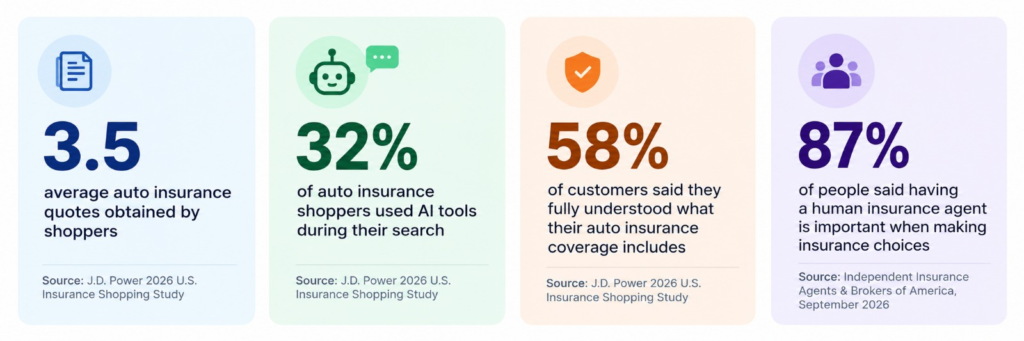
At the time about 32% of people shopping for auto insurance used AI tools during their search as reported by JD Power. But here’s the issue: 58% of customers said they fully understood what their auto insurance coverage actually included.
That leaves a gap. A big gap, between knowing a price and truly knowing what the policy protects. That’s where car insurance agents can step in. They can shift from being price providers to being trusted guides. Their job can become helping customers understand what the policy covers what it doesn’t and how it fits their real-life needs. In a world where AI does the quoting the human touch becomes more important.
What Drivers Should Know When Comparing Car Insurance Quotes
When looking at car insurance quotes cost is one part of the choice. Two policies that have prices can offer very different amounts of protection because of differences in deductibles, coverage limits, exclusions and who is eligible. This is where car insurance agents can help by making sure drivers know what they are really getting for their money.
- Check the coverage limits: Look at the liability and other coverage amounts in the policy of only looking at the price.
- Understand the deductible: A lower price can sometimes mean a deductible, which means paying more when there is a covered accident.
- Look for exclusions: See if the policy leaves out situations, drivers, uses of the car or types of damage that could cause problems later.
- Ask about coverage: Find out if things like rental-car coverage help with breakdowns or full coverage are part of the policy or need to be added separately.
- Understand usage-based insurance: If the policy uses driving data or a device to track how you drive ask how things like how much you drive or how you drive could change the price.
- Compare the policy, not the price: A lower price does not always mean a choice. People should look at the details of each policy before deciding.
The recent Insurify-Muse disagreement shows why this difference is important. Insurify said that using computers to get quotes could miss details, like coverage limits, deductibles, discounts, who is eligible and what needs to be told.
AI Is Changing the Agent’s Work
AI is also changing insurance agencies from the inside. A study called the 2026 Independent Agency Growth Study by Liberty Mutual found that 65% of insurance agents used AI for work in the past year, which is higher than 37% in 2025. Agents who used AI said they saved an average of four hours each week.
Common uses include summarizing meeting notes making marketing content looking at policy details and handling data tasks. This means agents can spend time on paperwork and more time on customer conversations and hard questions, about coverage.
Human Advice Still Has a Role
The increase in AI use does not mean people are ready to take humans out of insurance choices. A survey from September 2026 done by the Independent Insurance Agents & Brokers of America showed that 87% of people thought having a human insurance agent was important when they made insurance choices. The same survey also showed that 61% liked an agent who uses AI to customize coverage and make the insurance process go faster.
The results suggest a mix model for car insurance agents. AI for speed agents for context. AI can help customers look at information and do tasks faster. Agents can explain coverage answer questions and help drivers understand the details, in a policy.
What Comes Next for Car Insurance Agents?
As simple quotes and everyday tasks get more automated, car insurance agents might spend time on helping people with coverage choices, checking details, supporting claims and working with customers who have more complex insurance situations.
For drivers, the main change is straightforward: getting insurance quotes may be simpler. Knowing what the coverage includes will still be important. Car insurance agents are not just facing competition from quotes anymore. They are changing to fit a market where digital tools, artificial intelligence and personal advice are all part of the same insurance experience.
Frequently Asked Questions
Back to topAI can automate many routine tasks, including document work, meeting summaries and some policy comparisons. However, insurance agencies are also using human professionals to explain coverage, communicate with customers and handle more complicated situations.
AI can reduce time spent on repetitive work. The 2026 Independent Agency Growth Study found that agents using AI saved an average of four hours per week, with common uses including meeting summaries, marketing content, policy comparisons and routine data tasks.
Drivers should examine the coverage details behind any quote. A price alone does not show coverage limits, deductibles, exclusions, eligibility conditions or other policy terms. Recent developments involving AI insurance-shopping tools have highlighted the importance of keeping that context with the quote.
Ask about coverage limits, deductibles, exclusions, optional coverage, claims procedures, usage-based insurance and how changes in your driving or household situation could affect the policy.
Current industry data does not establish that conclusion. Instead, the evidence points to a changing role, with AI and digital tools handling more routine activities while agents continue to provide human guidance and more complex insurance support.
Bottom Line
The future of car insurance agents is likely to combine digital tools with human guidance. As AI makes comparing and buying policies faster, agents can focus more on explaining coverage, checking policy details, and supporting customers through complex decisions. For drivers, the real value may come from having both technology for speed and an expert who can provide the context behind the policy.