Does Closing a Credit Card Hurt Your Credit? What to Know Before You Cancel

Published:
11 min read
Finsery Editorial Team Finsery Editorial Team

Closing a credit card can affect your credit score, but it does not automatically cause your score to drop. The impact often depends on how closing the account changes your overall credit utilization, along with your broader credit history and the scoring model used. If you are considering canceling an unused card, avoiding an annual fee, or reducing the temptation to overspend, review the potential credit impact before making a decision. This guide explains what happens when you close a credit card, when closing one may make sense, and how to handle the process responsibly.

Does Closing a Credit Card Hurt Your Credit Score?

Closing a credit card can lower your credit score in some situations, particularly if it reduces your total available credit and increases your overall credit utilization ratio. However, the impact varies depending on your credit profile and the scoring model used.

Before closing an account, compare your total credit limits with your outstanding balances, evaluate the card’s costs and benefits, and consider whether you plan to apply for a major loan soon. The Consumer Financial Protection Bureau recognizes that closing a credit card can be reasonable in certain circumstances, even if it affects your credit score.

How Closing a Credit Card Can Affect Your Credit Score

Credit scoring models evaluate several aspects of your credit history. According to myFICO, FICO® Scores consider five major categories: payment history, amounts owed, length of credit history, new credit, and credit mix. Closing a credit card can affect your credit profile in different ways:

  • Credit utilization: Closing a card reduces your available credit limit. If your balances on other cards stay the same, your overall utilization may increase.
  • Length of credit history: A closed account in good standing can remain on your credit report for years. Closing the account does not necessarily reduce your average account age immediately.
  • Credit mix: Closing a card may affect the range of credit accounts you have, particularly if it is your only revolving account. However, the effect depends on your overall credit profile and the scoring model.

The impact of closing a card therefore depends on the details of your credit history, not simply on the number of cards you have.

How Closing Different Credit Cards Affects Credit Utilization

Your overall credit utilization ratio compares your total revolving credit card balances with your total available credit limits. Closing a card can reduce the available credit used in that calculation, even when your outstanding balances do not change.

Understanding how credit utilization affects your credit score can help you evaluate the potential impact before closing an account. Consider the following example: You have three credit cards with limits of $5,000, $3,000, and $2,000, and a combined balance of $2,000.

Scenario Total available credit Utilization
Keep all three cards $10,000 20%
Close the $2,000-limit card $8,000 25%
Close the $3,000-limit card $7,000 About 29%
Close the $5,000-limit card $5,000 40%

As the examples above show, your outstanding balances remain the same, but your total available credit decreases when you close an account. For instance, closing the card with the highest credit limit in this example increases your credit utilization from 20% to 40%.

Lower credit utilization is generally preferable for credit scoring, but 30% is not a universal threshold that determines whether every person’s score will rise or fall. The effect depends on your credit profile and scoring model. To estimate how changes in balances and limits affect your overall utilization, use Finsery’s credit utilization calculator.

What Happens to Your Credit Score After You Close a Card?
Does Closing a Credit Card Hurt Your Credit


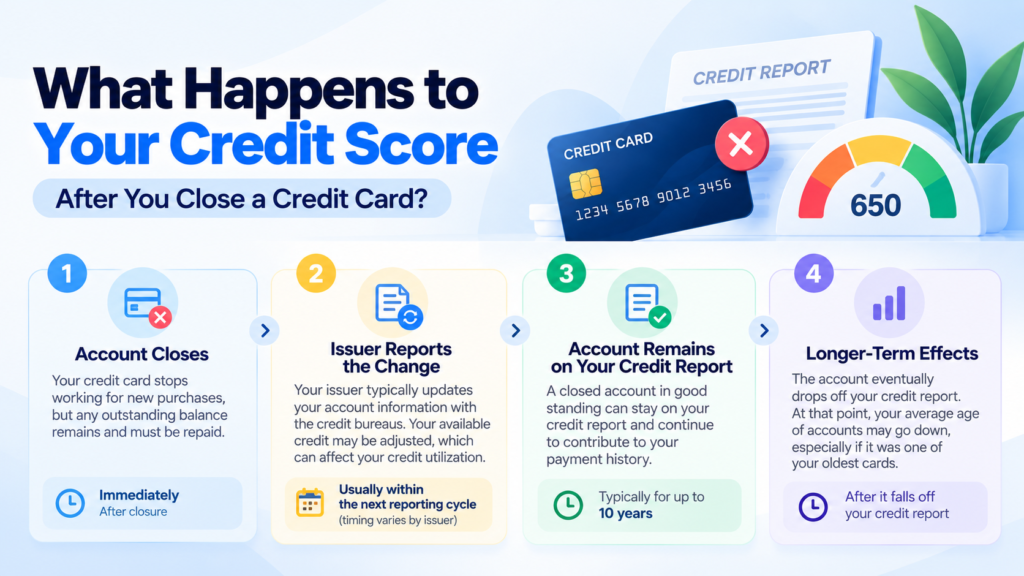
The effect of closing a credit card does not necessarily appear all at once. The timing depends on when the issuer reports the account’s updated status and balances, as well as how your overall credit profile changes.

When your credit card issuer completes processing the account closure, you will no longer be able to use the card for further transactions. But closing your account does not mean deleting all payment records associated with it or clearing any balance on the account. If there is an outstanding amount due, you still have to pay it.

There might not be any immediate effect on your credit score either. It depends on how much total credit limit you have, among other variables.

Credit card issuers will usually update your information at regular intervals to the credit reporting agencies. After your account is closed and the new credit limit reported, your total revolving credit could drop. As a result, you might see your utilization ratio rise, which can be problematic for your credit score depending on how it’s calculated by each agency.

Consider this example: Your total credit limit across all accounts is $10,000, with outstanding balances totaling $2,000. That results in an overall utilization ratio of 20%. Now, if you close one of those accounts, reducing the total credit available to $5,000 while keeping the balance constant at $2,000, then the ratio will double to 40%.

Keep in mind that there are many variables involved in determining how much this impacts your score.

Once you close your credit card account, it won’t disappear from your credit report instantly. A positively reported closed credit card could be kept by credit bureaus on file for about ten years. For those ten years, it will keep being a part of your overall credit report and potentially contribute to your credit scores.

Once this card expires, you might see your average account age recalculated based on whatever scoring system the bureaus use. If there was any negative information on it, such as missed payments, it would follow another set of guidelines, lasting no longer than seven years.

Having your accounts reported for some predetermined amount of time doesn’t automatically result in a decline in your credit score. It all depends on how you handle your credit in general.

Can You Close a Credit Card That Still Has a Balance?

Yes. You can generally request to close a credit card account even if you still owe a balance, subject to the issuer’s account terms and procedures. Closing the account does not eliminate the debt. You must continue making at least the required payments until the balance is paid off.

Interest may continue to accrue on an unpaid balance under the applicable card agreement. You should also confirm how the issuer will provide statements and accept payments after closure. The CFPB’s guidance on interest after account closure confirms that closing an account does not eliminate your outstanding balance or stop interest charges.

  • Outstanding Balance and Payments: You must continue making required payments after closing the card, as the outstanding debt remains and missed payments can negatively affect your credit report.
  • Interest After Closure: Interest may continue to accrue on unpaid balances, depending on your cardholder agreement.
  • Credit Reporting and Utilization: The closed account may remain on your credit report, while losing its credit limit may increase your overall utilization. Once repaid, it may show a zero balance.

For example, if you close a card with a $1,500 balance, you must continue making payments and may incur interest. After repayment, the account may show a zero balance and remain on your credit report for up to 10 years if it was in good standing.

How Long Does Closing a Credit Card Affect Your Credit Score?

There is no single timeline for how long closing a credit card may affect your credit score. The effect on utilization can occur when the account’s updated information is reflected in your credit profile. The account’s payment history may remain on your credit report after closure, so closing a card does not automatically erase its history.

Consider these four points:

  1. Utilization changes: Your utilization may change when the credit limit and account status are updated in your credit profile.
  2. Closed-account reporting: An account in good standing can generally remain on your credit report for up to 10 years.
  3. Account age: If a closed account eventually disappears from your credit report, it may affect account-history calculations depending on the scoring model.
  4. Negative information: Certain negative information can remain on a credit report for up to seven years, subject to the applicable reporting rules.

These periods describe credit reporting, not a guaranteed period during which your credit score will be affected. The impact can vary as your balances, payment history, and other credit information change. The CFPB’s explanation of credit-reporting periods outlines how long different types of information can remain on your credit report.

Should You Close a Credit Card or Keep It Open?

Whether a person closes the credit card account or not depends on many factors such as cost, benefit, credit limit, and usage of the credit card. Retaining the credit card account will help maintain credit availability, especially in case when the credit limit is high and there are no annual fees for using the card. It would be reasonable to close the credit card if its cost is higher than the benefits it brings or if the credit availability makes it difficult to handle the debt.

When Keeping a Card Open May Be Better

Keeping a card open may help preserve your available credit, particularly if it has a high limit and no annual fee. An older account in good standing can remain on your credit report for up to 10 years after closure, so closing it does not immediately erase its history. If the card offers valuable rewards or benefits, keeping it may also be worthwhile. However, monitor inactive accounts because the issuer may close them under its policies.

When Closing a Card May Make Sense

Closing a credit card may make sense if its annual fee outweighs the benefits, it encourages overspending, or its terms no longer suit your needs. Before canceling, ask the issuer about a no-annual-fee alternative. If you suspect fraud, contact the issuer to determine whether replacing or locking the card is more appropriate. Your financial well-being should take priority over preserving a particular credit score.

Which Credit Card Should You Close First?

If you have several credit cards and want to close one, compare the financial costs with the possible effects on your credit profile. The card with the highest annual fee is not necessarily the worst one to keep, and the oldest card does not automatically have to remain open.

Factor Better candidate to close Better candidate to keep
Annual fee Has a fee you cannot justify No annual fee
Credit limit Low limit High limit
Account age Newer account Older account
Rewards Perks you do not use Rewards you actively earn
Interest rate Higher APR Lower APR
Spending risk Tempts you to overspend Easy to manage responsibly

There is no single rule for which card you should close first. Compare the annual fee with the benefits you actually use, consider how much available credit you would lose, and review whether the card encourages spending you cannot comfortably repay. If you are preparing to apply for a mortgage or auto loan, consider discussing the potential impact with your lender before making a change.

What Are the Alternatives to Closing a Credit Card?

Closing out your credit card is just one way of reducing the cost of your card or restricting your spending through that credit card. There are other options depending upon your credit card company and circumstances.

  • Downgrade Your Card: Request that your issuer move you to a card with no annual fee to save money while keeping your account history and credit limit intact.
  • Raise Another Card’s Limit: Request that another card’s limit be raised to make up for the loss of credit from the closure of your account.
  • Lock Your Card: Use your issuer’s card lock function to prevent further purchases without closing the account.
  • Leave it Inactive: Do nothing if the card has no annual fee, though check in on it because the issuer might close it due to inactivity.
  • Pay Recurring Bills: Charge a small bill to your card monthly and pay off your statement balance on time to keep your account active.

Before closing a card to avoid an annual fee, ask the issuer whether a no-annual-fee product change is available. If your main concern is overspending, these steps to use credit cards without going into debt may help you manage your cards without necessarily closing an account. Consider whether locking the card or removing it from digital wallets would help. Choose the option that best addresses your financial situation rather than focusing on your credit score alone.

How to Close a Credit Card Without Missing Important Steps

A step-by-step approach to closing your credit card can help you avoid missed payments, lost rewards, and unexpected charges. Before requesting closure, review your outstanding balance and pending transactions, redeem any eligible rewards, and move recurring payments to another payment method. The Consumer Financial Protection Bureau (CFPB) also provides guidance on closing a credit card to help you understand the process and manage any remaining balance.

  • Review the account balance: See your outstanding balance, pending charges, and upcoming payments. Figure out how to settle the rest of your debts and see if there is any additional interest charged.
  • Rewards redemption: Look at your existing rewards, such as cash back, points, miles, and others. Try to redeem or transfer them as some companies can refuse to reward you after you close the account.
  • Transferring subscriptions and automatic payments: See what recurring charges you have connected with the card. Update all the information to avoid interruptions of services and fees.
  • Pending transactions and refunds: Check all your recent charges, pending transactions, and refunds before closing the account. If you are not sure how it will be done, contact the issuer.
  • Contact the issuer and close the account: Use the official way of closing the account from the issuer. Ask the issuer about your remaining balance, payment, and other requirements to close the account.
  • Written confirmation of the account closure: Ask for the official confirmation in writing that the account is closed to use it in case of problems in the future.
  • Monitor statements until all amounts are settled: Continue checking statements for outstanding balances, interest charges, refunds, and other transactions. Make all required payments on time, even after the account has been closed.

What Should You Do After Closing a Credit Card?

Closing a credit card is only the first step. After the account is closed, confirm that the issuer has processed your request and check that any remaining balance, interest charges, and pending transactions are handled correctly.

Confirm the Account Closure: Contact your card issuer or check your account records to verify that the account is closed. Keep written confirmation for your records, and make sure you know how to access statements if you still owe a balance.

Review Your Credit Reports: After the issuer has had time to report the change, review your credit reports to confirm that the account status and balance are accurate. If you find incorrect information, contact the issuer and dispute the error with the relevant credit reporting agency.

Continue Paying Any Remaining Balance: Closing your card does not eliminate outstanding debt. Continue making the required payments until the balance is paid in full, and review your statements for interest charges, refunds, and other adjustments. Because missed payments can harm your credit history, review what happens when you miss a credit card payment and how to avoid further damage.

Check Your Credit Reports for Free: You can obtain free credit reports from the major US credit reporting agencies through AnnualCreditReport.com. Remember that a credit report contains information about your credit history, while a credit score is a numerical assessment based on information in your credit profile.

Frequently Asked Questions

It can, mainly through utilization. Once the issuer reports the closure, your available credit drops and your utilization may rise. The timing depends on when your issuer reports to the bureaus, so the change does not always appear the same day.

Usually think twice. An older account contributes to your credit history, and it may also have a larger limit. Weigh that against any annual fee and the benefits you get. If the fee is the problem, ask about a no-fee version first.

It can. You owe nothing on that card, but you lose its credit limit. That reduces your total available credit, which can raise your utilization on your remaining cards even though your debt has not changed.

Does closing a credit card hurt your credit score? Closing a credit card can lower your credit score, especially if it reduces your total available credit and increases your credit utilization. However, the impact is not the same for everyone. Whether you want to cancel an unused credit card, avoid annual fees, control overspending, or simplify your finances, understanding how closing a credit card affects your credit score can help you make the right decision. Before you cancel, learn how credit utilization, account history, and your remaining credit limits may affect your score, when keeping an old credit card makes sense, and how to close an account responsibly.

Yes. Issuers can close accounts, and their terms and policies vary. Inactivity is one common reason. Check your cardholder agreement and any notice you receive.

In most cases, it is prudent to avoid unnecessary account changes before a major credit application. Reviewing your utilization first and talking with your lender can help you decide.

Be careful. Closing it means losing all your available revolving credit. Your history does not vanish overnight, since a closed account in good standing can stay on your report, but you will have no open card to keep building on.

What is Credit Utilization? How it Affects Your Credit Score

Published:
9 min read
Finsery Editorial Team Finsery Editorial Team

Credit utilization is the percentage of your available revolving credit that you’re using. It is calculated by dividing your reported balance by your total credit limit and multiplying by 100. Lower utilization is generally better for your credit scores, and people with the highest scores often have utilization below 10%. However, there is no universal percentage that guarantees a specific score.

How Credit Utilization is Calculated

Credit utilization is calculated by dividing your reported revolving balance by your total revolving credit limits, then multiplying by 100. If you have multiple cards, you can calculate utilization for each card separately or across all cards combined.

Per-card utilization is the percentage of one card’s balance compared with that card’s own limit. Overall utilization is the percentage calculated across your qualifying revolving balances and limits combined. Use the calculator below to see how both measures apply to your cards.

Finsery Credit Utilization Tool

How your credit utilization is calculated

Compare individual card utilization with your overall utilization.

Card 1

Card 1: Enter a credit limit and balance.

Card 2

Card 2: Enter a credit limit and balance.

Overall utilization

Total limit
—
Total balance
—

Overall utilization not calculated yet.

Enter a valid credit limit and balance for both cards to see your overall utilization.

Want to check with multiple cards? Use Finsery’s credit utilization calculator to calculate your multiple per-card and overall utilization.

Credit Utilization: What Different Utilization Levels Look Like in Dollars

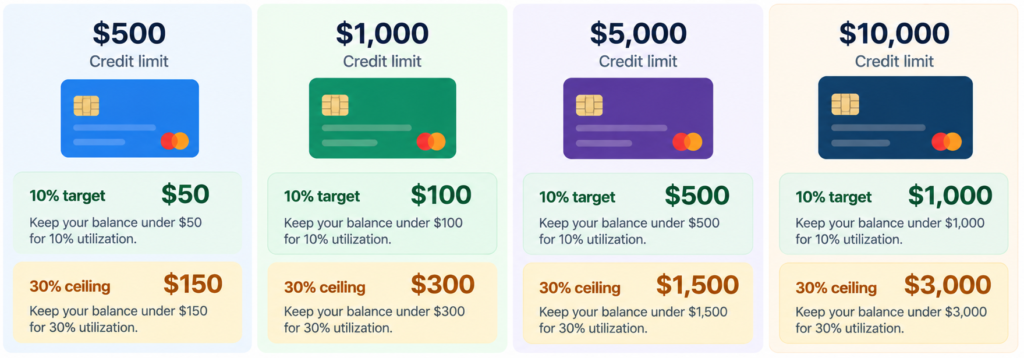
Here’s how much your balance would be at 10% and 30% utilization for different credit limits.

These amounts simply apply the utilization formula to each credit limit. A 30% utilization rate is a common benchmark, not a hard scoring cutoff. FICO says there is no single optimal percentage, and lower utilization is generally better.

What is a Good Credit Utilization Ratio?

A good credit utilization ratio is generally a low one. Under 30% is a practical benchmark, while single-digit utilization is often associated with the strongest FICO Score profiles. There is no universal percentage at which utilization suddenly changes from “good” to “bad.”

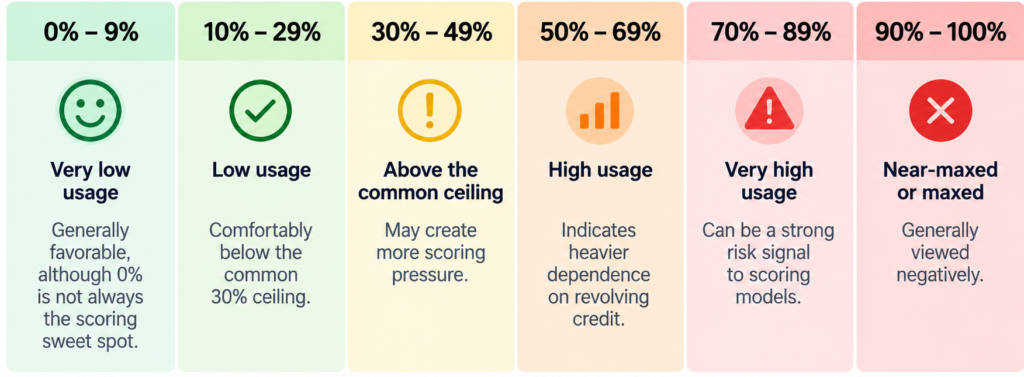
Here’s how different utilization levels compare:

The key point is that these bands describe direction and risk, not guaranteed score changes. A person moving from 70% to 40% may see a different result from someone moving from 20% to 8%, because scoring depends on the complete credit profile and the model being used.

Experian reported 28.3% average credit card utilization in March 2026, with utilization much lower among consumers with higher FICO Scores. Average utilization was 6.4% for Exceptional, 14.6% for Very Good, 38.5% for Good, 59.2% for Fair and 76.8% for Poor. These figures are based on Experian data from March 2026.

Is 30% bad? What about 50%, 70% or 100%?

Thirty percent is not a magic cutoff that automatically damages a score. It is better treated as a ceiling because utilization generally becomes less favorable as the percentage rises. FICO itself says the data does not support a single optimal 30% threshold.

At 50%, you are using half of the available revolving credit being measured. That is high enough to deserve attention, particularly if one card is close to its limit.

At 70%, utilization is very high and can be a significant negative factor. At 90% or 100%, a card is nearly maxed out or maxed out, which can signal a much heavier reliance on available credit.

Why High Utilization Lowers Your Credit Score

High utilization can lower your credit score because scoring models view high revolving balances relative to your limits as a sign that you may be relying heavily on available credit. This mainly applies to revolving credit, especially credit cards. FICO also considers personal lines of credit, while HELOCs are generally excluded from its utilization calculation.

The three major credit bureaus, Equifax, Experian and TransUnion, maintain your credit reports, and scoring models use the information reported there rather than monitoring your card activity in real time. For FICO Scores, amounts owed account for about 30% of the score, with utilization playing a major role within that category. Payment history is the largest factor at 35%.

VantageScore weights utilization differently. Its published VantageScore 4.0 framework assigns credit utilization a 20% weight, while other VantageScore explanations have put it at roughly 20% to 30%, depending on the model and source. The takeaway is simple: utilization is an important scoring factor, but its exact impact varies by scoring model.

Why does high utilization lower your score?

The underlying logic is risk. A person using a large share of a revolving credit line has less unused borrowing capacity and may look more financially stretched than someone using a small share.

What this does not mean: A low ratio does not replace on-time payments. Utilization also does not usually create a permanent penalty in the way a serious negative payment-history event can. When a newer reported balance falls, many scoring models can respond to that newer information.

What Credit Utilization Do Lenders Prefer on an Application?

There is no universal utilization percentage that every lender requires or prefers for approval. Lower revolving utilization can strengthen an application, but lenders also consider your credit score, credit history, income, existing debt and debt-to-income ratio. If you are preparing to apply for a major loan or a new card, reducing a high reported balance before the lender pulls your credit can help. The benefit depends on when your card issuer reports the updated balance to the credit bureaus.

A lender may still approve someone with 40%, 50% or higher utilization if the overall application is strong. Approval is an underwriting decision, not a utilization-score lookup. An issuer can also make its own decision based on criteria that are not part of your credit score. For example, income is not included in your credit score, but lenders may use it to assess your ability to repay and calculate your debt-to-income ratio.

Finsery view: Treat 30% as a benchmark, not a target. Lower utilization gives you more room for scoring-model differences, reporting timing and unexpected purchases.

Does Credit Utilization Matter If You Pay in Full?

Yes. Credit utilization can matter even when you pay your credit card in full every month because the reported balance, not necessarily your live balance, is what scoring models receive from the issuer.

A statement balance is the amount shown as owed when a billing cycle closes. A current balance is what your account shows you owe at a particular moment. A reported balance is the balance your card issuer sends to a credit bureau for that reporting update. A statement closing date is the date a billing cycle ends and the issuer generates the statement balance.

Many issuers report around the statement closing date, but schedules vary. Experian says issuers generally report around statement closing dates rather than the payment due date.

For the timing of the billing cycle itself, see our guide to what a credit card billing cycle is. Your credit card grace period is a separate concept from utilization: it concerns when you can generally avoid purchase interest by paying the statement balance on time.

How to Lower Credit Utilization

The fastest way to lower your reported ratio is usually to reduce the balance before the issuer reports it. Other strategies can help, but they can introduce costs, risks or timing uncertainty.

1. Pay before the statement closing date

This is usually the simplest and fastest lever when you have cash available.

Why it works
A smaller balance may be the one the issuer reports for that cycle.
When it does not
Your issuer may report on a different schedule or update at another point in the month.
Risk or cost
Paying early can strain your cash flow if you sacrifice money needed for other bills.

Finsery view: For most people, the fastest and cheapest lever is paying before the statement closing date, not opening another card. You can reduce the reported percentage without taking on another account.

2. Pay twice a month

Two payments can help keep the balance lower throughout the billing cycle and make large purchases easier to manage.

Why it works
Making payments during the billing cycle can lower the balance that gets reported to the credit bureaus.
When it does not
It may not help if your issuer reports a balance before your second payment is posted.
Risk or cost
There is no fee for making extra payments in most cases, but paying more often does not reduce your debt unless you are actually paying down the balance.

Finsery view: Paying twice a month can help keep your reported balance lower, but only if the payments post before your issuer reports the balance.

3. Request a credit limit increase

A higher limit can reduce the ratio even when the dollar balance stays unchanged.

Why it works
The same balance represents a smaller percentage of the line.
When it does not
The issuer may deny the request, may not report the new limit immediately, or could reduce your limit later.
Risk or cost
The issuer may perform a hard inquiry, which can affect your credit score. Some issuers use a soft inquiry or no credit check.

Finsery view: A higher limit can lower utilization without reducing your balance, but only request one if you can avoid taking on more debt.

4. Keep existing no-fee cards open

Why it works
Closing a card can remove available revolving credit and push your overall ratio higher.
When it does not
If the card has a meaningful annual fee or is causing you to overspend, keeping it open may not be worth the tradeoff.
Risk or cost
An unused account still needs to be monitored for fraud or unauthorized activity

Finsery view: Keeping a no-fee card open is usually smarter than closing it, unless it tempts you to overspend. The goal is useful available credit, not a larger wallet for its own sake.

5. Lower balances with larger one-time payments

Using a windfall, tax refund or other available cash to reduce card balances can bring utilization down quickly.

Why it works
It directly reduces the numerator in the utilization formula.
When it does not
If you are using the payment to avoid paying another essential bill, the tradeoff may be poor.
Risk or cost
Draining emergency savings to optimize a score can leave you financially weaker.

Finsery view: For a longer-term plan, focus on how you use cards rather than chasing a percentage every month. Our guide to using credit cards without going into debt covers that broader habit.

6. Update your income with the issuer

An updated income figure can sometimes support a higher credit limit, which can indirectly lower utilization.

Why it works
A higher income may make an issuer more comfortable extending additional credit.
When it does not
The issuer may leave your credit line unchanged.
Risk or cost
Never inflate your income. The information should be accurate and supportable.

Finsery view: Updating your income can support a higher credit limit, but it’s not a guaranteed way to lower utilization. Keep the information accurate and only report income you can reasonably support.

How Fast Does Your Score Recover After You Lower It?

A lower utilization ratio may help your score after the new balance reaches the credit report and the scoring model evaluates that updated information. There is no universal number of days or points because reporting schedules, scoring models and credit profiles differ.

In models that primarily use the latest reported balance, a lower balance can matter as soon as the new information is reported and the score is recalculated. TransUnion says there is no standard day for credit reports to update because TransUnion says lenders generally report around monthly but not on the same day.

Trended data is credit information collected over time that lets a scoring model evaluate patterns rather than only one snapshot. FICO Score 10T, for example, considers a historical view of balances and limits over roughly the previous 24 months or longer.

VantageScore 4.0 also incorporates trended credit data, giving the model a longer view of borrowing and payment patterns. VantageScore describes this as a way to see changes in behavior over time rather than relying only on static point-in-time information.

That means a one-month improvement can matter quickly in some models, while models that use historical trends may interpret the same improvement in the context of your longer pattern.

How much will lowering utilization change your score?

It can move your score in a favorable direction, but nobody can responsibly promise a specific point increase from utilization alone. The effect depends on the scoring model, your starting utilization, the rest of your credit profile and what other information changed at the same time.

Credit Utilization Myths

Myth: You need to carry a balance to build credit

Fact: You do not need to pay interest or carry debt from month to month to demonstrate responsible card use. A small reported balance can be useful in some scoring models, but that is different from carrying debt and paying interest

Myth: 30% is the exact cutoff

Fact: Thirty percent is a common benchmark, not a universal scoring cliff. FICO says there is no single optimal utilization percentage and that lower is generally better.

Myth: 0% utilization is always best

Fact: Not necessarily. FICO says having no revolving balance reported can be slightly less favorable than having a small reported balance, all else equal. That is why 1% to 9% is generally treated as a better target than deliberately forcing every card to report 0% every month. You do not need to carry interest-bearing debt to achieve that activity.

Myth: A high utilization ratio stays on your report for years

Fact: Utilization is generally a snapshot or, in some newer models, part of a trend. A high reported balance can hurt while it is being used by a scoring model, but lowering the balance can change the picture. FICO Score 10T is the key example of a model that considers longer-term trends.

Myth: Closing an old card always improves your credit

Fact: Closing an empty card can remove available credit and increase your overall utilization. The effect depends on your remaining balances, limits and credit profile.

Frequently Asked Questions

Thirty percent of a $5,000 credit limit is $1,500. You calculate it by multiplying $5,000 by 0.30. A $1,500 reported balance therefore represents 30% utilization on that card. Thirty percent is a common ceiling, not a guaranteed threshold for how a scoring model will treat your account.

Using 90% or 100% of a revolving credit limit creates very high utilization. That can negatively affect your credit score because a scoring model may interpret heavy use as greater repayment risk. A maxed-out card can also matter even when your overall utilization is lower because per-card utilization may be considered.

Paying twice a month can lower your reported utilization when the payments reduce the balance before your card issuer reports it. For example, paying $1,000 off a $1,200 balance before the reporting date leaves $200 to be reported. The number of payments itself does not improve the ratio; the lower reported balance does.

A $1,500 limit is not harmful by itself. The problem is that a low limit makes utilization rise quickly with ordinary spending. A $300 balance on a $1,500 limit is 20%, while the same $300 balance on a $5,000 limit is only 6%. Your limit also does not determine whether an issuer will approve future credit.

For a 10% target, $50 on a $500 limit equals 10%. For the common 30% ceiling, $150 equals 30%. These are utilization targets, not amounts you need to carry as debt. You can spend more during the billing cycle and make payments before the relevant reporting date to keep the reported balance lower.

No. A $70,000 salary does not translate to a fixed credit limit because issuers set credit lines individually. They can consider income, existing debts, credit history, scores, application information and their own underwriting policies. Income itself is not part of standard credit-score calculations, but lenders can use it when evaluating whether you can afford additional payments.

At 26.99% APR, a $3,000 balance carried for roughly one month would generate about $67 using the simple calculation $3,000 × 0.2699 ÷ 12 = $67.48. This is approximate and ignores daily compounding, the exact billing cycle and transaction timing. See our guide to credit card interest for how card interest actually works.

For a typical FICO Score, payment history is the largest category at 35%, followed by Amounts Owed at 30%, which includes utilization. That means paying on time should remain your first priority. Lowering utilization can help, but it does not compensate for a history of missed payments.

Closing a credit card can hurt your score when it reduces your available revolving credit and pushes your overall utilization higher. The effect depends on your balances, limits and complete credit profile. An account’s age and other factors may also matter. If the card has no fee and is not encouraging overspending, keeping it open can be the better choice.

High utilization can affect your score, while the high balance is reflected in the data used by the scoring model. Once lower balances are reported, newer-balance models may respond to that change. Models using trended data, such as FICO Score 10T and VantageScore 4.0, can also consider longer-term utilization patterns, so the effect is not identical across models.


How to Use Credit Cards Without Going Into Debt: A Step-by-Step Guide

Published:
6 min read
Finsery Editorial Team Finsery Editorial Team

How to Use Credit Cards Without Going Into Debt: A Step-by-Step Guide

Credit cards are powerful tools they offer rewards, protection, and convenience, but they can also trap you in expensive debt. In the U.S., consumers held over $1 trillion in credit card debt in the third quarter of 2023. Scripps News, citing FDIC data Average card interest rates are around 19.25% as of September 2026. Average Credit Card Interest Rates At 20%, carrying just $1,000 costs $200 per year in interest. The good news is that credit card debt is almost always avoidable. This guide outlines a repeatable system for spending, paying, and protecting your credit so you can use cards safely and avoid debt.

How Credit Card Debt Happens

A credit card is a revolving loan. When you use your card, the issuer pays for the purchase. You owe that amount back later. If you do not pay the statement balance by the due date, interest can be charged on the remaining balance. For example, if you carry a $500 balance at a 20% APR, a simple calculation puts the interest at $8 per month. Over time, these charges can add up and cause you to pay significantly more than the original amount you spent.

Your credit card statement shows details, including your new balance, minimum payment, available credit, and payment due date. According to CFPB, if you pay the new balance of your credit card by the payment due date, you generally avoid interest during the card’s grace period. However, if you do not pay the new balance, you may lose that grace period and begin accruing interest even on new purchases depending on your card’s terms. The simplest way to avoid this cycle is to treat your credit card as a payment tool rather than extra money: only charge what you already have the money to pay for and aim to pay the full statement balance on time and in full.

5-Step Debt-Free Card Routine

To stay out of credit card debt, create a simple monthly system that you can repeat every month, even if you use more than one credit card. The goal is to make sure every purchase is already accounted for before you make it, the money to pay for your purchases stays available, and your statement balance is paid in full when it is due.

Build-a-Debt-Free-Card-Routine
  1. Budget Your Spending: Before using your credit card, decide how much you can spend in each category based on your monthly budget. For example, you might set aside $300 for groceries, $100 for gas, and $150 for utilities. These amounts become your spending limits for the month, similar to keeping cash in separate envelopes.
  2. Charge Within Your Budget: Use your credit card only for expenses you’ve already planned and can afford. When you spend $50 on groceries, mentally treat that $50 as already spent rather than money that is still available. This helps prevent your credit card balance from growing beyond what you can comfortably repay.
  3. Set Aside the Cash: As you make credit card purchases, keep the money needed to pay for them in your checking or savings account. For example, if you’ve charged $50 for groceries and $40 for gas, you should have that $90 available for your eventual credit card payment. This way, your card balance is backed by money you already have.
  4. Pay the Full Balance: When your statement arrives, use the money you’ve set aside to pay the full statement balance by the due date. Paying the balance in full helps prevent your planned purchases from turning into revolving debt and allows you to use the card without continuously carrying a balance.
  5. Review and Repeat: After making your payment, review your statement and check that the transactions are correct. Look for purchases you don’t recognize, unexpected charges, or spending categories where you went over budget. Use what you learn to adjust your spending plan for the next month.

Following this cycle consistently makes credit card management more predictable. Instead of waiting for the bill to arrive and then figuring out how to pay it, you plan for the purchases first, keep the money available, and use your credit card as a payment tool rather than as extra spending money.

Practical Strategies to Manage Credit Cards Without Debt

Managing credit cards without getting into debt is about creating easy habits when it comes to spending, paying, and using credit. The main idea is to make sure that the things you buy fit into your budget, the amount you owe stays easy to handle, and you always pay on time. If you think of your credit card as a way to pay, not as money, you can build a daily routine that helps you avoid extra costs and keeps your money situation in check.

Aim to pay your full statement balance by the due date instead of relying only on the minimum payment. According to the CFPB, paying only the minimum can leave a balance that continues to accrue interest and may take much longer to repay. If you cannot pay the full balance one month, paying more than the minimum can help reduce the remaining balance and interest costs.

Decide how much you can safely spend before making credit card purchases. Set limits for categories such as groceries, gas, utilities, and entertainment, then track each purchase against those limits. This helps ensure that the money needed to pay your credit card bill is already accounted for in your budget.

Credit utilization is the percentage of your available credit that you’re using. For example, a $400 balance on a $1,000 limit represents 40% utilization. Keeping utilization below 30% is a commonly used guideline. U.S. Bank — How to Use Your Credit Card Wisely The source material also notes that some experts recommend keeping utilization closer to 10%–20%. Paying down a balance before the statement closes can also lower the utilization reported for that cycle.

One way to keep utilization lower is to pay down your balance before the statement closes. You can also consider requesting a higher credit limit if appropriate, while making sure the increase does not encourage additional spending.

Set up autopay for at least the minimum payment so you have a backup against missed due dates. If your budget and account balance allow it, you can automate the full statement balance instead. Calendar reminders and payment alerts can provide another layer of protection, especially when managing multiple cards with different due dates.

Regularly review your credit card transactions and statements to make sure your spending remains within your budget and to identify any unfamiliar charges. Transaction alerts can help you monitor purchases throughout the month, while reviewing your statement gives you an opportunity to check your balance, payment information, and spending before the next billing cycle.

How to Manage Multiple Credit Cards Without Going Into Debt

Having multiple credit cards can be useful when each card has a clear purpose. The key is to keep your spending organized and make sure you can manage every balance and payment.

Build-a-Debt-Free-Card-Routine

Use Different Cards for Different Expenses

One card can be used for monthly bills, such as utilities, phone bills, or insurance, works well. Then use another card for expenses, like groceries, gas, and dining. Fixed expenses are easier to plan for because you know what they will cost each month. Variable spending requires monitoring. No matter which card you use, keep each purchase within your budget. Plan to pay the balance in full.

Use Rewards Only for Planned Purchases

If one of your cards gives you cash, miles or other things you can get back use those things only for things you were going to buy anyway. For example, a card that gives you travel rewards might be good for a hotel booking if you already have the money to pay for it. The rewards should never be the reason you spend more than you can afford. Paying the amount every time is how you make sure the rewards are not canceled out by the interest you have to pay.

Make Multiple Due Dates Easier to Manage

Using cards means you have to keep track of multiple payment due dates. If your card issuers let you change your payment date, think about setting them together. That way you can handle all your payments at once each month. For example, having all your cards around at the same time makes it easier to remember when to pay. It also helps make sure you have money in your account when the payments come due.

Keep Your Number of Cards Manageable

There is no one number of credit cards that works for everyone. The main thing to think about is whether you can be sure you are keeping track of your spending, the amounts you owe, and the dates you need to pay. The information says that one or two cards might be better for people who want to stay out of debt. Having more cards can make your money matters more complicated. If you have cards, only use them when you can handle each one and keep paying what you owe as you planned.

Understand Your Credit Card Statement and Terms

Your credit card statement gives you the information you need to understand what you owe, when your payment is due, and what could happen if you don’t pay on time. Reviewing these details each month can help you avoid missed payments, unexpected fees, and unnecessary interest. For more information, see the CFPB’s credit card statement requirements.

Statement Section What It Tells You
Summary of Account Activity Shows your transactions and provides details such as your new balance, previous balance, payments, and credits.
Payment Information Shows your total new balance, minimum payment due, and payment due date. The statement also explains when a payment is considered on time.
Minimum Payment Warning Shows how long it could take to pay off your balance if you make only the minimum payments and how much you could pay over that period. This helps demonstrate why paying more than the minimum can be important.
Late Payment Warning Explains potential fees and the possibility of a higher APR if your payment is late. Your issuer may also apply a penalty interest rate under the terms of your account and must provide the required notice before certain rate increases.

Make it a habit to review these sections whenever your statement arrives. Knowing what you owe, when your payment is due, and what your account terms mean can help you stay organized and avoid unnecessary credit card costs.

Paying the Minimum vs. Paying More

The amount you pay each month can make a big difference in how long it takes to clear a credit card balance and how much interest you pay. Paying only the minimum can keep the balance around for years, while paying more each month can reduce both the repayment time and total interest. For more information, see our guide to how credit card minimum payments work.

Consider a card balance of $3,000 at 24% APR. If you only pay the $100 minimum each month, you would pay about $717 in interest over 32 years before the balance is gone; you’d end up paying $3,717 total. But if instead you pay $300 per month, you’d clear the balance in under a year and pay only about $144 in interest.

Finsery’s Credit Card Payoff Calculator can help you see how different monthly payment amounts affect your repayment timeline and total interest. The key lesson is simple: paying more each month can significantly reduce the interest you pay and help you become debt-free sooner.

Frequently Asked Questions

There is no single number that works for everyone. For people focused on avoiding debt, the source suggests that one or two cards may be easier to manage, while having more cards can increase the complexity of tracking spending, balances, and payment dates. The key is to use only as many cards as you can confidently manage.

No. Paying the full statement balance by the due date can generally help you avoid interest during the grace period. Credit cards can be used as a payment tool without carrying a balance from month to month, as long as your spending stays within your budget and you pay on time.

Build your credit card payments around the money you actually have available. Budget your spending before using the card, keep enough cash available to cover your purchases, and use automatic payments or reminders to help avoid missed due dates. Aligning payments with your payday can also help you avoid cash-flow problems.

Rewards can be useful when they are tied to purchases you already planned to make. The source recommends using rewards cards for planned spending rather than allowing rewards to encourage additional purchases. Most importantly, paying the balance in full helps prevent interest from reducing the value of those rewards.

Start by avoiding new debt and create a plan to pay down your balances. Paying more than the minimum can reduce interest and shorten your repayment time. Finsery’s Credit Card Payoff Calculator can help you compare different payoff scenarios.


What Credit Score Do You Need for Different Credit Cards? A Complete Guide

Published:
7 min read
Finsery Editorial Team Finsery Editorial Team

Wondering what credit score you need for a credit card? The answer depends on the card you want and your overall credit profile. A score that may qualify you for a secured or starter card may not be enough for a premium rewards or travel card. In this guide, we’ll break down the credit score needed for different credit cards, what issuers look for beyond your score, and how to prepare before applying.

What Credit Score Do You Need for Different Credit Cards?

Credit Score Ranges for Different Credit Cards

Your credit score gives you an idea of what type of credit cards you might qualify for, but your credit score is not the only consideration that card issuers take into account when deciding whether to issue a card.

For FICO® Scores, the commonly used ranges are:

FICO® Score Credit RangeCredit Range Credit Card Types You May Consider
300–579 Poor Secured and credit-building cards
580–669 Fair Starter, secured and some unsecured cards
670–739 Good Mainstream, cash-back and rewards cards
740–799 Very Good Rewards, travel and premium cards
800–850 Exceptional Broad range of credit card categories

These credit score ranges can give you a general idea of which credit cards may fit your profile, but they are not guaranteed approval requirements. Card issuers may also consider factors such as your credit history, income, debt, and payment history when reviewing an application.

What Does Your Credit Score Mean for Credit Card Eligibility?

Your credit score can help you identify credit cards that may fit your profile. If you have bad or fair credit, you can consider credit cards designed for beginners and credit building. With good, very good, or exceptional credit, you may have access to a wider range of rewards, cash-back, travel, or premium cards. According to the Consumer Financial Protection Bureau, your credit score is one factor companies may use when deciding whether to offer you credit.

But remember that your high credit score doesn’t guarantee approval for any card. The kind of credit card is another important factor. For example, a secured credit card, student credit card, and travel premium card can have entirely different requirements even if issued by the same bank. This is the reason why it’s helpful to look at both your credit score and overall credit situation before applying

Student credit cards are generally designed for college students who may have limited credit histories.


You don’t necessarily need an excellent credit score to qualify for every student card. Because students may be new to borrowing, issuers can consider other eligibility factors in addition to traditional credit-score information.


Student cards may offer features such as

  • Cash-back rewards
  • No annual fee
  • Credit-building opportunities
  • Student-focused benefits

If you’re a student with limited credit history, comparing cards based on eligibility, fees, and features may be more useful than focusing on the highest possible rewards rate.

Cash-back credit cards are available across different credit profiles, although the requirements vary significantly between cards.


Applicants with good credit or better may have access to a wider selection of cash-back cards, while some cards are designed for people with fair or limited credit.


Cash-back cards can reward spending through:

  • Flat-rate cash back
  • Bonus categories
  • Rotating categories
  • Store-specific rewards

Before applying, compare the rewards structure with the card’s annual fee, APR, and other terms.

Rewards cards typically offer points, miles, or cash back in exchange for eligible purchases.


Many rewards cards are aimed at applicants with good to excellent credit, although requirements vary by issuer and product.


Depending on the card, rewards may include:

  • Cash back
  • Travel points
  • Airline miles
  • Hotel points
  • Flexible rewards points

A higher credit score may expand the number of rewards cards you can consider, but the best fit also depends on how you spend and whether you can pay your balance on time.

Travel credit cards can range from basic cards with simple rewards to premium cards with extensive travel benefits.


Many premium travel cards are targeted toward consumers with good to excellent credit.


Depending on the card, benefits may include:

  • Travel rewards
  • Airline or hotel points
  • Introductory bonuses
  • Airport lounge access
  • Travel-related protections

Don’t choose a travel card based on the credit score requirement alone. Annual fees, rewards, redemption options, and benefits can make a significant difference in the card’s overall value.

A 0% introductory APR credit card can be useful for eligible purchases or balance transfers because it may temporarily reduce interest charges.


These cards commonly target applicants with good to excellent credit, but each issuer sets its own eligibility requirements.


Before applying, check:

  • Length of the introductory APR period
  • Regular APR after the introductory period
  • Balance transfer fee
  • Annual fee
  • Purchase and balance-transfer terms

A 0% APR offer is temporary, so it’s important to understand what happens when the introductory period ends.

Balance transfer cards are designed to allow eligible cardholders to move debt from one credit card to another, subject to the issuer’s terms.


Many balance transfer cards are targeted toward consumers with good or excellent credit. But your credit score isn’t the only number that matters.


Before considering a balance transfer, look at:

  • Current credit card balance
  • Existing APR
  • Promotional APR
  • Length of the promotional period
  • Balance transfer fee
  • Expected monthly payment
  • Regular APR after the promotional period

A balance transfer may reduce interest costs in some situations, but the transfer fee and promotional-period terms should be included when comparing your options.

What If Your Credit Score Is Too Low for the Card You Want?

Just because your existing credit score does not match up with what is usually the profile of the credit card you wish to apply for does not automatically mean that you should not pursue this credit card anymore. It is possible that continuing to apply for credit cards that are outside of your credit profile will not work for you.

What If Your Credit Score Is Too Low for the Card You Want

Pay Your Bills on Time

One of the most critical habits that one needs to adopt in order to keep good credit standing is timely payment of credit cards. Payment history reflects how timely you pay off your debts. Failure to do so may be damaging to your credit standing. In order to avoid any unintentional failure to make the payment, it is best to set up an automatic payment for at least the minimum required payment due.


The fact that you make payments regularly does not imply that you must pay your complete amount monthly to remain in good standing with your creditor. In addition, making your payment in full whenever possible could be advantageous in order to avoid paying any interest on your purchases.

Reduce Your Credit Card Balances

Another area worth considering is the balances on your credit cards and credit utilization. The credit utilization shows the relation between the revolving credit utilized by you and the total credit available to you. Suppose the total limit of your credit cards is $10,000 and you have utilized a total of $3,000. In this case, your credit utilization will be 30%.


If you reduce your credit card balances, it will bring down your credit utilization. Suppose you reduce your total credit card balances from $3,000 to $1,500, but the total credit available is still $10,000. Then, your credit utilization will fall from 30% to 15%.


As far as credit utilization is concerned, it varies with the balances and reported information. Furthermore, there is no particular utilization figure that can assure you of increasing your credit scores. To check your credit card balances, you may use the Credit Card Utilization Calculator provided by Finsery.

Avoid Unnecessary Credit Card Applications

If you are looking to get approved for certain credit cards, it might seem wise to apply for many at once to improve your chances of being approved. However, every single application for a new card could result in an inquiry into your credit history, and this could impact your credit profile.


The best course of action would be to investigate certain credit cards and look at all of their features and terms to determine whether or not they match your credit profile and are worth considering. In some cases, credit card companies have prequalification tools that could allow you to see if you meet their criteria without the same kind of hard inquiry that an application would generate.

Review Your Credit Reports

If your credit score turns out to be lower than anticipated, getting your credit reports might assist you in understanding how you look on your credit reports. You should be on the lookout for any unknown accounts, wrong balances, wrong payment history information, duplicated accounts, or any other piece of information that does not belong to you.


If you notice any information that is inaccurate, you will have a chance to dispute it with the relevant credit reporting agency, as well as the provider of that information, if any. Checking your credit report before opening any new credit line might enable you to rectify any mistakes in advance.


You can also request your credit reports from Equifax, Experian, and TransUnion through the official Annual Credit Report. You can review your reports for inaccurate information, unfamiliar accounts, or other errors before applying for a new credit card..

Give Your Credit History Time

Constructing a good credit profile usually takes time. If you have just created your credit profile or reduced any balances or rebuilt your credit profile after facing some issues in payments in the past, then you will not necessarily notice all these changes instantly.


The information about the account usually gets reported periodically, and the information that is taken into consideration to calculate your credit score keeps changing with the update of your credit report. There can be a different impact of any activity because of the use of a different scoring model or based on other information of your credit report. Instead of trying to increase your credit score quickly, you should concentrate on keeping yourself consistent with your activities.

How Credit Utilization Fits Into Your Credit Profile

Credit utilization describes how much of your available revolving credit you’re currently using. It is commonly expressed as a percentage and can help you understand how your current credit card balances compare with your available credit limits.

For example, if your credit card has a $2,000 credit limit and your current balance is $500, your credit utilization would be

$500 ÷ $2,000 × 100 = 25%

This means you’re currently using 25% of the available credit on that card.

If you have multiple credit cards, you can also look at your overall credit utilization by combining the balances and credit limits across your cards. For example, if you have two cards with a combined credit limit of $5,000 and combined balances of $1,000, your overall utilization would be 20%.

Moreover, one more thing that should be considered when using the credit utilization rate is the possibility of its changing based on balance and credit limit fluctuations. The balance used by a creditor for assessing the credit score is not necessarily equal to the balance available in your statement on the day of the assessment. There are various ways to evaluate revolving utilization by credit scoring models.

In other words, monitoring your utilization ratio will allow you to obtain more information about your current credit situation, especially when planning an application for a new credit card.

When having several credit cards, calculation of your credit utilization ratio can become rather challenging. Use Finsery’s Credit Card Utilization Calculator to calculate your current credit utilization before applying for a new credit card.

What Credit Score Do You Need for a $5,000 or $10,000 Credit Limit?

No certain credit score is needed to ensure a $5,000 or a $10,000 limit. There are no certain rules when it comes to credit limits since lenders usually consider additional factors aside from credit score when determining how much credit they are willing to extend. The factors may include your income, debts, payment record, your credit history, and others depending on the data you provide with your application.

As an illustration, two people with quite similar credit scores may be offered different limits due to differences in their financial and credit profiles. A person who has been dealing with credit responsibly and has a lower debt level compared to the other individual may have a different application profile despite the similar credit scores. That is why there is no single algorithm according to which a certain credit score ensures a credit limit of $5,000 or $10,000.

If you’re looking for a higher credit limit, consider your overall credit profile rather than focusing only on your score. Your current credit card balances and utilization can also provide useful context before you apply. Finsery’s Credit Card Utilization Calculator can help you calculate your current utilization across one or multiple cards so you can better understand where you stand.

Pro Tip

If you have multiple credit cards, check both your individual and overall credit utilization. Finsery’s Credit Card Utilization Calculator can help you calculate it before applying.

Does a Higher Credit Score Mean a Higher Credit Limit?

While a high credit score indicates that you might have access to credit cards that offer a high credit limit, this doesn’t necessarily guarantee you’ll get the higher limit. Credit card issuers will determine what the credit limit should be based on their criteria of underwriting. This means they may take into account various factors including your credit score, income level, debt, payment history, and many others.

For instance, two applicants with the same credit score but with different levels of debt will receive a different credit limit. Also, someone who has been in the practice of handling multiple credit accounts over the years is likely to be viewed differently from someone who has just joined the fray recently. The bottom line here is that your credit score is just one among many things.

Instead of considering your credit score as a way to gauge your eligibility for getting more credit, consider it to be an indication of your overall credit profile. Being aware of your payment pattern, balances, and credit utilization rate can give you some insight on how your credit stands.

How to Prepare Before Applying for a Credit Card

Before applying for a new credit card, take a few minutes to understand your current credit profile and the card you’re considering. Checking your credit score, reviewing your credit reports, and understanding your existing balances can help you make a more informed decision before submitting an application.

Before you apply, consider the following:

  • Check your credit score: Know your current credit score and understand which credit range you fall into. This can help you identify credit cards that generally fit your profile.
  • Review your credit reports: Check your credit reports for accurate account information, balances, payment history, and accounts you recognize. If you find inaccurate information, consider disputing it with the appropriate credit reporting company.
  • Check your credit utilization: Review how much of your available revolving credit you’re currently using. If you have multiple credit cards, look at both individual and overall utilization.
  • Review the card’s terms: Check the annual fee, APR, rewards, introductory offers, balance-transfer terms, foreign transaction fees, and other applicable charges before applying. For more guidance, read our guide on how to choose a credit card.
  • Consider your existing debt: If you already carry balances on other credit cards, consider how adding another account could affect your overall debt and monthly payments.
  • Check eligibility requirements: Review the issuer’s stated requirements before submitting a full application. If a prequalification tool is available, you may be able to check whether you are likely to qualify before applying.
  • Avoid unnecessary applications: Don’t apply for several credit cards simply because you are unsure which one you’ll qualify for. Research your options first and apply when a card fits your credit profile and financial needs.

Taking these steps can help you approach a credit card application with a clearer understanding of your credit profile, the card’s terms, and what you’re committing to before you apply.

Frequently Asked Questions

There is no single credit score required for every credit card. Generally, secured and credit-building cards may be available to people with lower scores, while rewards and premium cards often have higher credit requirements.r

Yes. A 600 credit score may qualify you for certain secured, starter, or credit-building credit cards. Approval depends on the issuer’s requirements and your overall credit profile.

A FICO Score of 670 to 739 is generally considered good. This range may provide access to a wider selection of mainstream credit cards, although approval requirements vary by issuer.o

A higher credit score can be one factor associated with higher credit limits, but it does not guarantee one. Issuers may also consider income, debt, payment history, credit history, and other application information.

You can work on your credit profile by making payments on time, managing credit card balances, reviewing your credit reports for errors, and limiting unnecessary credit applications. Over time, these habits may help strengthen your credit profile.r


Best Credit Cards to Build Credit for Beginners in October 2026

Updated:
7 min read
Finsery Editorial Team Finsery Editorial Team

Best Credit Cards to Build Credit for Beginners

Best Credit Cards for Beginners to Build Credit

If you’re starting your credit journey, the right first credit card can help you build a strong credit score, qualify for better financial products, and avoid costly mistakes. The best beginner credit cards in 2026 prioritize approval accessibility, low fees, and credit-building features over rewards. After reviewing beginner-friendly cards based on approval difficulty, fees, credit reporting policies, and upgrade options, we found these to be the best credit cards for building credit. The first two picks are unsecured, so there is no deposit. The last three are secured, which means a refundable deposit makes approval easier if you have no credit or poor credit.

1. Chase Freedom Rise

The Chase Freedom Rise is built for people who are new to credit and want an unsecured card with no security deposit. It earns a flat 1.5% cash back on every purchase, and Chase automatically reviews your account each year for an upgrade to the Chase Freedom Unlimited.

Best unsecured starter: Beginner credit card
Chase Freedom Rise® Credit Card
JPMorgan Chase Bank, N.A.
Chase Freedom Rise® Credit Card
Rates & Fees

Last updated October 1, 2026

Earn 1.5% cash back on purchases
Build credit with responsible use
Pay $0 annual fee
Beginner Credit Card Credit Builder No Annual Fee Unsecured Starter Card

Chase Freedom Rise® Cash Back Rewards

Earn unlimited 1.5% cash back on all purchases while building credit. Rewards do not expire as long as your account stays open, and there is no minimum to redeem for cash back. Redeem for a statement credit, a deposit into an eligible Chase account, gift cards, travel, or Amazon checkout.

Pros

  • No annual fee and no security deposit
  • Flat 1.5% cash back on every purchase
  • Automatic yearly upgrade review to Chase Freedom Unlimited®
  • Credit line increase review in as soon as 6 months
  • Built-in purchase, warranty, and trip protections

Cons

  • A Chase account with $250+ improves approval odds for first-time cardholders
  • 3% foreign transaction fee
  • 5% balance transfer fee (minimum $5)
  • No bonus categories beyond a limited-time Lyft offer
  • High APR if you carry a balance
Annual Fee
$0
No annual fee card
Monthly Fee
$0
No monthly maintenance fee
Balance Transfer Fee
$5 or 5%
Greater of $5 or 5% of each transfer
Foreign Transaction Fee
3%
3% of each transaction in U.S. dollars
Cash Advance Fee
$10 or 5%
Greater of $10 or 5% of each advance
Late Payment Fee
Up to $40
Late payment penalty applies
Regular APR
18.24% – 27.74%
Variable APR based on creditworthiness
Balance Transfer APR
18.24% – 27.74%
Same variable APR as purchases
Cash Advance APR
Up to 29.99%
Variable; higher than the purchase APR. Check Chase's pricing and terms for your exact rate
Penalty APR
None
Penalty APR not specified
Intro APR
None
No intro APR offer
Intro APR Duration
None
No intro APR period

Requirements

Credit Score Needed
Poor (below 650) — New to credit or limited credit history
Card Network
Visa
Global Visa payment network
Card Type
Personal
Starter unsecured credit card
Minimum Credit Line
$500+
Depends on approval profile

Additional Information

The Chase Freedom Rise® card is designed for people who are new to credit and want simple cash back while building a credit history. It has no annual fee and no security deposit. If you have never had a credit card, having at least $250 in a Chase checking or savings account can improve your approval chances, though it is not required and does not guarantee approval. Chase automatically reviews your account each year for an upgrade to Chase Freedom Unlimited®, and you can be considered for a credit line increase in as soon as 6 months. Chase may ask for additional verification after you apply, such as a U.S.-issued driver’s license and Social Security card.

Disclaimer: Card details, rates, fees, and offers may change at any time. We aim to keep this information current but cannot guarantee it will stay accurate, and we are not responsible for issuer updates or errors. Always verify terms on the issuer's website and do your own research before applying.

Why we picked it: We selected this card because it is an unsecured starter card with no annual fee and a clear upgrade path. If you have never had a credit card, keeping at least $250 in a Chase checking or savings account can improve your approval chances.

2. Capital One Platinum Credit Card

The Capital One Platinum Credit Card is an unsecured option for people with fair or limited credit who don’t want to tie up money in a security deposit. It has no annual fee and no foreign transaction fee, and Capital One may automatically consider you for a higher credit line in as little as six months. It doesn’t earn rewards, and its 28.99% variable APR is high, so pay your balance in full each month.

Best secured card: Low deposit
Capital One Platinum Secured Credit Card
Capital One, N.A.
Capital One Platinum Secured Credit Card

Last updated October 1, 2026

Build credit with low refundable deposit
Pay $0 annual fee
Get automatic credit line reviews
Beginner Credit Credit Builder No Annual Fee Secured Credit Card

Credit Building Program

This card is designed to help you build or rebuild credit through responsible use and on-time payments. Capital One reports your account activity to all three major credit bureaus. After as little as 6 months you can be automatically considered for a higher credit line with no additional deposit, and you may work toward earning your refundable deposit back.

Pros

  • Deposit as low as $49 for a $200 credit line
  • Automatic credit line review in as little as 6 months
  • No annual fee, no foreign transaction fee, and no penalty APR
  • Check if you pre-qualify without a hard credit check
  • Reports to all three major credit bureaus

Cons

  • Security deposit required
  • No rewards program
  • Low $200 starting limit unless you deposit more
  • High 28.99% variable APR
Annual Fee
$0
No annual fee
Monthly Fee
$0
No monthly maintenance fee
Balance Transfer Fee
$0 or 4%
$0 at the transfer APR; 4% of each transferred balance at a promotional APR Capital One may offer you
Foreign Transaction Fee
$0
No foreign transaction fees
Cash Advance Fee
$5 or 5%
5% of the advance, but not less than $5
Late Payment Fee
Up to $40
Late payment penalty applies
Regular APR
28.99%
Variable APR; high, as is typical for secured cards
Balance Transfer APR
28.99%
Same variable APR as purchases
Cash Advance APR
28.99%
Variable; same as the purchase APR
Penalty APR
None
No penalty APR
Intro APR
None
No intro APR on purchases or balance transfers
Intro APR Duration
None
No intro APR period

Requirements

Credit Score Needed
Poor (below 650) — Limited or poor credit; no credit score required to apply
Card Network
Mastercard
Global Mastercard network
Card Type
Secured
Credit builder secured card
Minimum Credit Line
$200+
Starts at $200 with a $49, $99, or $200 deposit (based on your profile); up to $1,000 with a larger deposit

Additional Information

The Capital One Platinum Secured Credit Card is built for people with limited or poor credit who want a low-cost way to start or rebuild a credit history. Depending on your application, your refundable security deposit is $49, $99, or $200, and your credit line starts at $200 in every case. That makes it one of the few secured cards where the credit line can be larger than the deposit. You can pick a higher line, up to $1,000, by depositing more, and you can see if you pre-qualify without a hard credit check. There is no annual fee, no foreign transaction fee, and no penalty APR, and Capital One automatically considers you for a higher line in as little as 6 months. The trade-offs are no rewards and a high 28.99% variable APR, so pay your balance in full each month.

Disclaimer: Card details, rates, fees, and offers may change at any time. We aim to keep this information current but cannot guarantee it will stay accurate, and we are not responsible for issuer updates or errors. Always verify terms on the issuer's website and do your own research before applying.

Why we picked it: We chose this card because it pairs no deposit with no annual fee and a quick credit line review. If your credit is poor or you have no history at all, a secured card like the Capital One Platinum Secured below may give you better approval odds.

3. Discover It Secured

The Discover it Secured Credit Card is one of the few secured cards that earns cash back. You earn 2% at gas stations and restaurants on up to $1,000 in combined purchases each quarter and 1% on everything else, with a refundable deposit starting at $200.

Best secured card: Cash back rewards
Discover it® Secured Credit Card
Discover Bank
Discover it® Secured Credit Card

Last updated October 1, 2026

Build credit with refundable $200+ deposit
Get Cashback Match first year
Earn cashback rewards
Beginner Credit Card Credit Builder No Annual Fee Secured Card

Discover Cashback Bonus®

Earn 2% cash back at gas stations and restaurants on up to $1,000 in combined purchases each quarter, and 1% on everything else. Discover also matches all the cash back you earn during your first year. Rewards never expire while your account is open and can be redeemed as a statement credit, an electronic deposit, at select merchants, or for gift cards.

Pros

  • Cash back rewards, which are rare on secured cards
  • Dollar-for-dollar Cashback Match after your first year
  • No annual fee and no foreign transaction fee
  • No late fee on your first late payment and no penalty APR
  • Automatic reviews to move to an unsecured card

Cons

  • $200 minimum refundable deposit
  • High 26.49% variable APR
  • Discover is not accepted everywhere outside the U.S.
  • Deposit must be funded from a bank account
Annual Fee
$0
No annual fee
Monthly Fee
$0
No monthly maintenance fee
Balance Transfer Fee
3% intro, then up to 5%
3% intro fee on qualifying transfers; up to 5% on future balance transfers
Foreign Transaction Fee
$0
No foreign transaction fees
Cash Advance Fee
$10 or 5%
Greater of $10 or 5% of each cash advance
Late Payment Fee
Up to $41
No late fee the first time you pay late; up to $41 after that
Regular APR
26.49%
Variable APR (Prime Rate plus a margin)
Balance Transfer APR
10.99% intro, then 26.49%
10.99% intro APR for 6 months, then the variable purchase APR
Cash Advance APR
28.49%
Variable APR; higher than the purchase APR
Penalty APR
None
No penalty APR for paying late
Intro APR
10.99%
Intro APR on balance transfers only; no intro APR on purchases
Intro APR Duration
6 months
Applies to balance transfers only

Requirements

Credit Score Needed
Poor (below 650) — No credit score required to apply; for building or rebuilding credit
Card Network
Discover
Discover payment network
Card Type
Secured
Credit builder secured card
Minimum Credit Line
$200+
Equals your refundable security deposit ($200 to $2,500)

Additional Information

The Discover it® Secured Credit Card is one of the few secured cards that earns cash back and charges no annual fee. Your credit line equals your refundable security deposit, which can range from $200 to $2,500, and you provide bank account information when you submit it. Discover reports to the three major credit bureaus and starts automatic reviews at around 7 months to see if you can move to an unsecured line of credit and get your deposit back. Discover does not charge a late fee the first time you pay late and does not raise your APR for a late payment. Discover is accepted at most U.S. merchants but may not be accepted in all countries outside the U.S.

Disclaimer: Card details, rates, fees, and offers may change at any time. We aim to keep this information current but cannot guarantee it will stay accurate, and we are not responsible for issuer updates or errors. Always verify terms on the issuer's website and do your own research before applying.

Why we picked it: We chose this card because Discover matches all the cash back you earn in your first year, and it begins automatic reviews at around seven months to see if you can move to an unsecured card and get your deposit back.

4. Capital One Platinum Secured

The Capital One Platinum Secured Credit Card lets you start with a $200 credit line for a refundable deposit of $49, $99, or $200, depending on your profile. It has no annual fee and no foreign transaction fee, but it doesn’t earn rewards.

Best no-deposit starter: Fair or limited credit
Capital One Platinum Credit Card
Capital One, N.A.
Capital One Platinum Secured Credit Card

Last updated October 8, 2026

Build credit with no security deposit
Pay $0 annual fee
Get automatic credit line reviews
Beginner Credit Credit Builder No Annual Fee Unsecured Starter Card

Credit Building Program

This card does not earn rewards. It is built to help you establish or improve credit with responsible use, without a security deposit. After as little as 6 months of on-time payments, Capital One may automatically consider you for a higher credit line.

Pros

  • No security deposit required
  • No annual fee and no foreign transaction fee
  • Automatic credit line review in as little as 6 months
  • $0 fraud liability and free CreditWise monitoring
  • Open to people with fair or limited credit

Cons

  • No rewards program
  • High 28.99% variable APR with no intro offer
  • May be hard to get approved with poor credit
  • Starting credit limit is not guaranteed
Annual Fee
$0
No annual fee
Monthly Fee
$0
No monthly maintenance fee
Balance Transfer Fee
$0 or 4%
$0 at the transfer APR; 4% of each transferred balance at a promotional APR Capital One may offer you
Foreign Transaction Fee
$0
No foreign transaction fees
Cash Advance Fee
$5 or 5%
5% of the advance, but not less than $5
Late Payment Fee
Up to $40
Late payment penalty applies
Regular APR
28.99%
Variable APR; high, so avoid carrying a balance
Balance Transfer APR
28.99%
Same variable APR as purchases
Cash Advance APR
28.99%
Variable; same as the purchase APR
Penalty APR
None
No penalty APR
Intro APR
None
No intro APR on purchases or balance transfers
Intro APR Duration
None
No intro APR period

Requirements

Credit Score Needed
Fair (650–699) — Fair or limited credit; best odds with a FICO score of about 580 or higher
Card Network
Mastercard
Global Mastercard network
Card Type
Personal
Unsecured starter credit card; no security deposit
Minimum Credit Line
Set by Capital One based on your application; eligible for a review in as little as 6 months

Additional Information

The Capital One Platinum Credit Card is a no-frills, unsecured card for people with fair or limited credit who want to build a history without paying a security deposit. It has no annual fee and no foreign transaction fee, and Capital One may automatically consider you for a higher credit line in as little as 6 months. It includes $0 fraud liability, free CreditWise credit monitoring, and account alerts through Eno, the Capital One assistant. The trade-offs are no rewards and a high 28.99% variable APR with no intro offer, so pay your balance in full each month. If your credit is poor, you may have better approval odds with a secured card such as the Capital One Platinum Secured.

Disclaimer: Card details, rates, fees, and offers may change at any time. We aim to keep this information current but cannot guarantee it will stay accurate, and we are not responsible for issuer updates or errors. Always verify terms on the issuer's website and do your own research before applying.

Why we picked it: We chose this card for the lowest deposit among our picks and an automatic credit line review in as little as six months, which can raise your limit without more money down.

5. Capital One Quicksilver Secured

The Capital One Quicksilver Secured Cash Rewards Credit Card earns unlimited 1.5% cash back on every purchase, plus 5% on hotels, vacation rentals, and rental cars booked through Capital One Travel. It requires a refundable deposit of at least $200.

Best secured card: Flat-rate rewards
Capital One Quicksilver Secured Cash Rewards Credit Card
Capital One, N.A.

Last updated October 1, 2026

Earn unlimited 1.5% cash back on every purchase
Refundable deposit from $200, $0 annual fee
Get automatic credit line reviews
Beginner Credit Cash Back Credit Builder No Annual Fee Secured Credit Card

Capital One Cash Rewards

Earn unlimited 1.5% cash back on every purchase, every day, plus 5% cash back on hotels, vacation rentals, and rental cars booked through Capital One Travel. Capital One reports your account activity to the credit bureaus, and you can be considered for a higher credit line in as little as 6 months. You may also work toward earning back your refundable deposit as a statement credit through responsible use.

Pros

  • Unlimited 1.5% cash back, rare on a secured card
  • 5% back on hotels, vacation rentals, and rental cars via Capital One Travel
  • No annual fee, no foreign transaction fee, and no penalty APR
  • Automatic credit line review in as little as 6 months
  • Refundable deposit

Cons

  • $200 minimum security deposit
  • High 28.99% variable APR with no intro offer
  • Low $200 starting credit limit
  • No welcome bonus
Annual Fee
$0
No annual fee
Monthly Fee
$0
No monthly maintenance fee
Balance Transfer Fee
$0 or 4%
$0 at the transfer APR; 4% of each transferred balance at a promotional APR Capital One may offer you
Foreign Transaction Fee
$0
No foreign transaction fees
Cash Advance Fee
$5 or 5%
5% of the advance, but not less than $5
Late Payment Fee
Up to $40
Late payment penalty applies
Regular APR
28.99%
Variable APR; high, so avoid carrying a balance
Balance Transfer APR
28.99%
Same variable APR as purchases
Cash Advance APR
28.99%
Variable; same as the purchase APR
Penalty APR
None
No penalty APR
Intro APR
None
No intro APR on purchases or balance transfers
Intro APR Duration
None
No intro APR period

Requirements

Credit Score Needed
Poor (below 650) — Limited or poor credit
Card Network
Mastercard
Global Mastercard network
Card Type
Secured
Secured card with flat-rate cash back
Minimum Credit Line
$200+
Starts at $200 and is set by your refundable security deposit (minimum $200)

Additional Information

The Capital One Quicksilver Secured Cash Rewards Credit Card is the rewards-earning version of Capital One’s secured card for people with limited or poor credit. You put down a refundable deposit of at least $200, which sets your starting credit line, and you earn unlimited 1.5% cash back on every purchase plus 5% on hotels, vacation rentals, and rental cars booked through Capital One Travel. There is no annual fee and no foreign transaction fee, and Capital One may automatically consider you for a higher credit line in as little as 6 months. The trade-offs are the $200 minimum deposit, which is higher than the $49 entry point on the Capital One Platinum Secured, and a high 28.99% variable APR, so pay your balance in full each month.

Disclaimer: Card details, rates, fees, and offers may change at any time. We aim to keep this information current but cannot guarantee it will stay accurate, and we are not responsible for issuer updates or errors. Always verify terms on the issuer's website and do your own research before applying.

Why we picked it: We chose this card for its simple flat-rate rewards, with no categories to track, no annual fee, and a possible credit line review in as little as six months.

How We Chose the Best Beginner Credit Cards

Our editorial team reviewed dozens of starter credit cards from major issuers to identify the best options for beginners. We prioritized cards that are accessible to new credit users and offer strong credit-building potential and long-term value.

We focused on accessibility for beginners rather than on premium rewards, as approval and credit-building are more important when starting out. This method aligns with major financial publishers, who evaluate starter cards based on eligibility, fees, and credit-building features, based on guidance from Consumer Financial Protection Bureau and major credit bureaus.

Primary Factors

We prioritized these factors because they directly affect a beginner’s ability to qualify for a card and build credit.

  • Approval difficulty: We focused on cards designed for applicants with no credit, limited credit, fair credit, or student profiles.
  • Annual fees: We preferred cards with no or low annual fees to minimize costs for beginners.
  • Credit bureau reporting: Only cards that report to all three major credit bureaus (Experian, Equifax, and TransUnion) were considered.
  • Upgrade opportunities: We rated cards higher if they offer graduation to unsecured cards, credit limit increases, or product upgrades.
  • Security deposit requirements: For secured cards, we evaluated minimum deposits, flexibility, and refund policies.
  • Issuer reliability: We preferred established issuers with strong customer support and security standards.
  • Interest rates (APR): Although beginners should avoid carrying balances, we ranked cards with excessively high APRs lower.

Secondary Factors

These factors were used to differentiate cards once primary requirements were satisfied:

  • Rewards structure: Cashback or straightforward rewards programs were viewed as additional benefits rather than primary considerations.
  • Mobile app features: Account management, payment alerts, and spending trackers.
  • Credit monitoring tools: Free credit score access and educational resources were considered beneficial.
  • Customer experience: Issuer reputation, service quality, and overall user experience were evaluated.
  • Fraud protection features: Zero liability coverage and transaction alerts.
  • Financial education tools: Cards providing educational resources for beginners received additional consideration.
  • Account management flexibility: Autopay options, due date flexibility, and digital statements.
  • Foreign transaction fees: Considered for beginners who may travel or make international purchases.

How to Choose the Right First Credit Card

Choosing your first credit card is less about maximizing rewards and more about finding a card you can qualify for and use to build a strong credit foundation. The right beginner credit card should match your financial situation, approval chances, and long-term credit goals. If you’re new to credit, focus on these key decision factors before applying. You can also read our detailed guide on how to choose a credit card to understand key features, fees, and eligibility factors before making a decision.

How to Choose the Right First Credit Card

How Beginners Can Build Credit Faster

When used responsibly, your first credit card can help you establish a credit profile within months and improve your credit score within the first year. Since credit scores depend on payment history, credit usage, and account age, beginners can make steady progress by adopting disciplined habits.

Follow these proven strategies to build credit faster and avoid common beginner mistakes:

Who Should Apply for a Beginner Credit Card?

Beginner credit cards are intended for individuals new to credit or with limited credit history. These cards generally offer easier approval and help users build a solid financial foundation.

  • First-time credit users: If you have never used credit before, a beginner credit card can help you establish your credit profile. Responsible use, including timely payments and low balances, can generate your first credit score within a few months. This is often the first step toward qualifying for more favorable financial products.
  • Students: Students often have limited income and no credit history, making beginner or student credit cards a practical starting point. These cards typically feature easier approval and may offer educational resources. Building credit early helps students establish a strong credit history before entering the workforce.
  • Young professionals: If you have recently started your first job, a beginner credit card can help you build financial credibility. With a steady income, you may also qualify for entry-level unsecured cards. Establishing credit early supports future loan, housing, and premium credit card approvals.
  • Immigrants building U.S. credit: New immigrants often need to build credit from the beginning, as foreign credit history typically does not transfer to the U.S. system. Beginner credit cards, particularly secured cards, can help establish a new credit profile. This is important for renting housing, financing purchases, or qualifying for better financial products.
  • Anyone with a thin credit history: Even with existing credit accounts, you may have a “thin credit file” if your history is limited. Beginner cards can strengthen your profile by adding positive payment history. Over time, this can improve your credit score and expand your financial opportunities.

Summer Credit Card Tips: 7 Smart Ways to Save & Earn More

Published:
4 min read
Finsery Editorial Team Finsery Editorial Team

Summer credit card tips can help you save money, earn rewards, and avoid unnecessary fees during one of the most expensive seasons of the year. Travel, dining, and shopping costs rise quickly, but with the right strategy, your credit card can become a powerful financial tool instead of a burden.

Rather than overspending or racking up interest, you can earn rewards, cut costs, and keep your finances on track. Many savvy shoppers use more than one card to get the most out of spending on travel, groceries, and fuel.This guide shares seven practical, expert-approved tips to help you make the most of your credit cards this summer.

1. Use the Right Credit Card for Your Summer Spending

Summer spending often increases in categories such as travel, fuel, dining, and entertainment. Relying on one card for all purchases can limit your rewards. To maximize value, match each expense category with the card that offers the highest return.

Strategy:

  • Identify your top 3 summer expenses (travel, fuel, dining, groceries)
  • Assign the best card for each category.
  • Use a flat 2% cashback card for all other spending.
  • Review your past spending to optimize card usage.

2. Pay in Full and Control Your APR

Credit cards are most effective when you avoid interest charges. According to the Consumer Financial Protection Bureau (CFPB), paying your full statement balance supports financial health, protects your credit score, and reduces unnecessary costs.

Strategy:

  • Always pay the full statement balance rather than only the minimum.
  • Set up auto-pay to ensure payments are made on time.
  • Maintain credit utilization below 30%.
  • Avoid using credit for expenses beyond your means.

3. Use 0% APR Offers Smartly

0% APR offers can help manage large expenses by allowing interest-free payments for a set period. To avoid high debt after the promotional period, it is essential to plan your repayment carefully. The Federal Reserve reports that average credit card interest rates are significantly higher than most loans, making 0% APR offers valuable when used responsibly.

Strategy:

  • Use 0% APR offers only for planned and necessary expenses.
  • Divide the total amount by the number of promotional months and pay that amount each month.
  • Set reminders to ensure you pay off the balance before the offer expires.
  • Avoid making multiple large purchases at once using 0% APR offers.

4. Avoid or Reduce Fees

Fees can reduce your credit card benefits. Many users overlook costs from annual fees, foreign transaction fees, and penalties. Keeping your cards cost-efficient ensures your rewards translate into real savings.

Strategy:

  • Choose no-annual-fee cards unless the benefits outweigh the cost.
  • Use no-foreign-transaction-fee cards for travel.
  • Pay bills on time to avoid late fees.
  • Review your cards regularly and downgrade or close those with high fees that you do not use.

5. Budget and Track Spending

Summer travel and social events can lead to impulsive spending. Without tracking, expenses are harder to manage. Credit card tools can help you monitor and maintain your budget in real time.

Strategy:

  • Establish a clear budget for travel, dining, and shopping.
  • Enable spending alerts in your credit card app.
  • Monitor your spending weekly rather than monthly.
  • Adjust your spending immediately if you exceed your set limits.

6. Maximize and Redeem Rewards Wisely

Earning rewards is only the first step; maximizing their value requires thoughtful redemption. Many users miss out on bonuses or redeem points inefficiently. Strategic earning and redemption can help lower your overall expenses.

Strategy:

  • Regularly activate rotating bonus categories.
  • Use the card that offers the highest rewards for each purchase.
  • Combine multiple cards to maximize returns.
  • Redeem rewards for cashback or high-value travel options.

7. Stay Safe and Plan Backup Options

Increased travel and online transactions during the summer raise the risk of fraud. Losing a card or encountering unauthorized transactions can disrupt your plans. Preparing security measures and backup options helps ensure safe, uninterrupted spending.

Strategy:

  • Enable instant transaction alerts.
  • Avoid public Wi-Fi for financial transactions.
  • Carry a backup card separately.
  • Use digital wallets for emergency access.
  • Report lost or suspicious activity immediately.

Best Credit Card Types for Summer Spending

The best card for you depends on your summer spending habits. Some cards work well for travel, while others offer more cashback on daily purchases. This short guide will help you find the right fit for your lifestyle.

Card Type Best For Key Benefit Ideal User
Cashback Cards Daily spending (groceries, fuel, dining) 2%–6% cashback on purchases Users who want simple savings
Travel Rewards Cards Flights, hotels, international travel Points, travel perks, no foreign fees Frequent travelers
0% APR Cards Large purchases Interest-free period (12–15 months) Budget planners
Flat-Rate Cards Mixed spending Fixed 2% cashback on everything Beginners / simple usage

Frequently Asked Questions

The best summer credit card tips include using the right card for each category, paying your balance in full, avoiding fees, and tracking your spending regularly. These steps help maximize rewards while preventing unnecessary costs

Using multiple cards is generally better because you can maximize rewards across different categories like travel, groceries, and fuel. However, it requires proper tracking and discipline.

To avoid interest, always pay your full statement balance before the due date. You can also use 0% APR offers for large purchases, but ensure you repay before the promotional period ends.

Yes, travel credit cards are valuable if you travel frequently. They offer benefits like reward points, travel insurance, and no foreign transaction fees, which can save money on international trips.

Set a clear budget, enable spending alerts, and track your expenses weekly. This helps you stay within limits and avoid financial stress after the season ends.


Credit Card Application Declined? 9 Reasons and What to Do Next

Updated:
6 min read
Finsery Editorial Team Finsery Editorial Team

A declined credit card application can be frustrating, especially when you have a good credit score or have never missed a payment. But credit card companies consider more than your score when deciding whether to approve you. Your application may be denied because of high existing debt, limited credit history, insufficient income, too many recent applications, or even incorrect information on your credit report.

The good news? A rejection does not mean you will never qualify for a credit card. This guide explains nine common reasons credit card applications get rejected, how denial affects your credit score, and what you can do before applying again.

Why Was My Credit Card Application Declined?

A credit card application is declined when the issuer determines that an applicant does not meet its approval requirements. Each issuer evaluates applicants using its own lending criteria. These may include credit scores, payment history, income, existing debt, and information from previous accounts.

Why Was My Credit Card Application Declined?

1. Your Credit Score Is Too Low

Your credit score is one of the factors lenders use to evaluate your creditworthiness. A lower score can indicate a history of missed payments, high balances, or other financial difficulties.

For commonly used FICO scoring ranges:

Credit Score Classification
300–579 Poor
580–669 Fair
670–739 Good
740–799 Very Good
800–850 Exceptional

These categories describe credit score ranges, not guaranteed approval requirements. For example, a person with a 640 credit score might qualify for one credit card but be rejected for another. To understand how payment history, credit utilization, and other factors affect your credit profile, read our guide on how credit scores work.

2. Your Credit Utilization Is Too High

Credit utilization measures how much of your available revolving credit you are using. Even if all your payments are made on time, a high utilization ratio can have a negative effect on your credit score and might affect the issuer’s decision. This factor can be improved by lowering the amounts that you report.

A credit utilization ratio below 30% is commonly used as a general guideline, but it is not a universal requirement for credit card approval. Lower utilization can generally be better for credit scoring, but its impact varies based on your overall credit profile. For a more direct source on utilization, use an authoritative credit-scoring explanation from FICO: Amounts owed and credit utilization. Use Finsery’s Credit Utilization Calculator to calculate your overall and per-card utilization and estimate how much you may need to pay down to reach your chosen target.

3. You Have Applied for Too Many Credit Cards Recently

If you keep getting denied for credit cards, frequent applications may be contributing to the problem. When you submit a credit card application, the issuer will typically perform a hard credit inquiry. Multiple recent credit applications can be considered as part of an issuer’s assessment of your overall credit profile, particularly when combined with other risk factors such as existing debt or several recently opened accounts. For example, applying for five credit cards within a short period may affect your chances of approval. Consider checking whether an issuer offers prequalification using a soft inquiry, which can help you explore potential options without affecting your credit score, although it does not guarantee approval.

4. Your Income Is Insufficient

A strong credit score alone does not guarantee approval for a credit card. Issuers may consider your income, existing debt, and ability to manage additional payments when evaluating your application. For example, if you earn $3,000 per month but already have substantial monthly debt payments, an issuer may determine that additional credit would create too much repayment risk. An application may also be declined if the income you report cannot be verified or does not meet the issuer’s requirements.

5. You Have Little or No Credit History

When your initial credit card application is rejected, this could mean that you have insufficient credit history, also referred to as thin credit history. You could earn well and owe nothing but still lack sufficient information regarding your borrowing behaviors. Having a thin credit history differs significantly from having bad credit history. While having a thin credit history refers to having very little or no experience with borrowing, having bad credit history implies a past marked by numerous defaults or late payment incidences.

6. Your Credit Report Contains Negative Information

Negative information on your credit reports, such as late payments, collection accounts, or charge-offs, can affect your ability to qualify for a new credit card. The impact depends on factors such as the type, severity, and recency of the information, as well as the issuer’s credit criteria. If you have recent or serious negative information on your credit report, an issuer may consider you a higher-risk applicant. Such entries can stay on your credit reports for many years.

7. Your Existing Debt Is Too High

Some people are denied credit cards even though they have good credit scores. One possible reason is the amount of debt they already carry. An issuer may review your existing financial obligations and determine that additional borrowing would be difficult to manage.

For example:

Financial Detail Amount
Gross monthly income $4,000
Monthly mortgage payment $1,500
Monthly car loan payment $600
Other monthly debt payments $500
Total monthly debt payments $2,600

In this example, the debt-to-income ratio is 65%. This illustrates how existing monthly obligations can take up a substantial portion of income. Credit card issuers do not all use the same debt-to-income requirements, so this example should not be treated as a universal approval threshold.

8. Your Application Contains Incorrect Information

Your credit card application does not necessarily get denied because of your credit score. An application may also be rejected when the issuer cannot verify the information provided. For example, there may be an error in your Social Security number, discrepancies in your identifying information, an outdated mailing address, or inaccurate income information. Make sure the information on your application is accurate and consistent with the information the issuer can verify.

9. You Do Not Meet the Card Issuer's Specific Requirements

Credit card issuers all have different qualifications for approval. Therefore, even if you meet credit requirements, you will not necessarily qualify for approval by any issuer. During evaluation of the application, the issuer considers various details regarding your financial situation. Your application might be denied based upon having multiple new credit accounts or owing money to that particular issuer previously. If you are unsure which types of cards may fit your credit profile, explore our guide to credit score requirements for different credit cards

Why Am I Getting Denied for Credit Cards With Good Credit?

Having a good credit score can strengthen your credit profile, but it does not guarantee credit card approval. Issuers evaluate several factors beyond the score displayed in your banking app. You might have a good credit score and still be denied because:

  • Your income is insufficient relative to your obligations.
  • You have opened too many accounts recently.
  • Your credit utilization is high.
  • Your credit history is limited or does not provide enough information for the issuer to evaluate your application.
  • The issuer uses a different credit scoring model.
  • You do not meet a particular card’s eligibility requirements.

For example, someone with a 750 credit score could still be declined if they recently opened several credit accounts, carry high outstanding balances, or do not meet the issuer’s other eligibility requirements. This illustrates why reviewing your overall financial profile is more useful than focusing on your credit score alone.

Another important point is that the credit score shown by a free monitoring service may differ from the score used by a particular lender. Different credit bureaus and scoring models can produce different results. The Consumer Financial Protection Bureau explains that a credit score obtained by a consumer may not be the same score a lender uses.

Does Getting Rejected for a Credit Card Affect Your Credit Score?

Getting rejected for a credit card does not directly lower your credit score, but the hard inquiry associated with your application may affect it. When you apply for a credit card, the issuer generally checks your credit report through a hard inquiry, which can influence your score whether your application is approved or denied. This distinction is important because the rejection itself does not create a separate scoring penalty.

Consider these situations:

Situation Potential credit score impact
Your application is rejected No separate scoring penalty for rejection itself
The issuer performs a hard inquiry May temporarily affect your score
You check your own credit report No credit score impact
An issuer performs a soft prequalification check No credit score impact from the soft inquiry

The Consumer Financial Protection Bureau confirms that hard inquiries may affect credit scores, while soft inquiries do not.

What Happens If Your Credit Card Application Is Denied?

For credit card applications in the United States, federal law generally requires creditors to provide an adverse action notice when an application is denied or other adverse action is taken. The notice explains the principal reasons for the decision. In many cases, creditors must notify applicants of the decision within 30 days after receiving a completed application. The notice may also explain how to request additional information about the decision.

If your credit report was part of the reason your credit card application was denied, the issuer must provide details. Those details include the contact information of the credit reporting agency, the credit score that was used and the fact that you have the right to request a copy of your credit report.

If your application was denied based on information in a consumer report, you can request a free copy of the report from the consumer reporting agency identified in the adverse action notice. Federal law generally gives you 60 days from receiving the notice to request this report.

What to Do After Your Credit Card Application Is Declined

A declined credit card application does not mean you cannot qualify for a credit card in the future. Instead of applying again immediately, take a few practical steps to understand the reason for rejection and address any issues that may affect your eligibility.

Follow this step-by-step process:

  1. Read Your Adverse Action Notice: Identify the specific reasons your credit card application was denied and understand which factors may need attention.
  2. Check Your Credit Reports: Review your credit reports for inaccurate balances, unfamiliar accounts, missed payments, and other information that may have influenced the issuer’s decision.
  3. Dispute Inaccurate Information: If you find errors, submit a dispute to the relevant credit bureau or information provider with supporting documents.
  4. Review Existing Debt and Credit Utilization: Examine your outstanding balances, available credit limits, and monthly debt obligations to identify areas you may need to improve.
  5. Make Payments on Time: Pay at least the minimum amount due by each payment deadline and maintain a consistent payment history.
  6. Check Prequalification Options: Explore suitable credit cards that offer prequalification through a soft credit inquiry, if available, before submitting another formal application.
  7. Reapply When You Are Ready: Once you have addressed the relevant issues, review the issuer’s eligibility requirements and consider applying for a card that matches your current financial profile.

How to Avoid Credit Card Application Denials

Although credit card approval is never guaranteed, taking a few steps before applying can help you avoid common mistakes and choose a card that better matches your financial situation.

  • Check Your Credit Reports Before Applying: Review your credit reports for inaccurate balances, unfamiliar accounts, incorrect payment information, and other potential errors. Checking your own credit reports does not hurt your credit score. Correcting inaccurate information before applying may help prevent a lender from making decisions based on incorrect data.
  • Choose a Card That Matches Your Credit Profile: Research the card’s eligibility requirements before submitting an application. If you are establishing credit for the first time or have a limited credit history, consider starter or secured credit cards rather than immediately applying for premium travel rewards cards with potentially stricter requirements.
  • Reduce High Credit Card Balances: Paying down outstanding credit card balances may lower your credit utilization and reduce your existing debt burden. Review your balances and available credit limits to understand your current utilization. Use Finsery’s Credit Card Utilization Calculator to see how your reported balances compare with your available credit.
  • Check Whether Prequalification Is Available: Check whether the issuer offers a prequalification tool that uses a soft credit inquiry. This can help you explore potential card options without affecting your credit score through the prequalification check. However, prequalification does not guarantee approval, and submitting a formal application may still trigger a hard inquiry.
  • Avoid Unnecessary Applications: Apply selectively instead of submitting multiple applications in the hope that one issuer will approve you. Each formal application may result in a hard inquiry, and several recent applications could raise concerns for some lenders. If you have been denied before, review the reasons for rejection and address the relevant issues before applying again.

Frequently Asked Questions

You may be denied a credit card because of insufficient income, high credit utilization, existing debt, limited credit history, recent credit applications, or inaccurate application information. Each issuer has its own approval criteria. Review your adverse action notice to understand the specific reasons for your rejection.

A good credit score does not guarantee credit card approval. Issuers also evaluate your income, existing debt, recent credit inquiries, account history, and eligibility for the specific card. Even with a strong credit score, high outstanding balances or multiple recently opened accounts may affect your application.

A credit card rejection itself does not directly lower your credit score. However, the hard inquiry associated with your application may temporarily affect your score. Checking your own credit report or using a prequalification tool that performs a soft inquiry generally does not affect your credit score.

There is no universal waiting period after a credit card application is denied. Before applying again, review the adverse action notice and address the reason for the denial. If the issue was high credit utilization, existing debt, inaccurate information, or too many recent applications, give yourself time to address the underlying issue before submitting another application. You should also review the new card’s eligibility requirements to make sure it matches your current credit profile.

Generally, yes. Under applicable U.S. rules, creditors must provide the specific reasons for denying a credit application or explain how you can request them. This information is commonly provided through an adverse action notice. If your credit report influenced the decision, the notice generally includes information about the credit reporting agency and your right to request a free credit report.

Secured credit cards and certain starter or student credit cards may be more accessible to applicants with limited credit history or difficulty qualifying for traditional cards. A secured card typically requires a refundable security deposit, which often determines the initial credit limit. However, approval is not guaranteed, and eligibility requirements vary by issuer. Compare fees, deposit requirements, and reporting practices before applying.

Start by reading your adverse action notice to identify the reason for the denial. Then, check your credit reports for inaccurate information, review your existing debt and credit utilization, and make upcoming payments on time. If your credit profile needs improvement, address the relevant issues before applying again. You can also check whether suitable cards offer prequalification through a soft credit inquiry.


What is a Credit Card Minimum Payment and How Does it Work?

Published:
6 min read
Finsery Editorial Team Finsery Editorial Team

When you get your credit card statement, you’ll notice a minimum payment listed. This is the smallest amount you need to pay to avoid late fees and keep your account in good standing. Although paying just the minimum might seem easier, it can end up costing you more in interest and take longer to pay off your balance.

Knowing how minimum payments work can help you avoid extra debt and make smarter choices about paying your credit card. In this guide, we’ll cover what a credit card minimum payment is, how it’s figured out, and how it can change the amount of interest you pay and how long it takes to pay off your card.

What is a Credit Card Minimum Payment?

A credit card minimum payment is the lowest amount due each month to keep your account active and avoid late fees. This amount appears on your statement as the minimum due. Paying only the minimum protects your credit score from late payments, but the remaining balance will continue to accrue interest.

The minimum payment is typically 1% to 3% of your balance, or a fixed amount of $25 to $40, whichever is higher. It includes part of your balance, interest charges, and any fees or overdue amounts. Paying more than the minimum reduces interest costs and helps you pay off debt faster. According to the Consumer Financial Protection Bureau, making only the minimum payment can significantly increase the total interest paid over time.

How is a Credit Card Minimum Payment Calculated?

In the US, credit card companies use a standard formula to figure out your minimum payment. This formula ensures you pay off a small portion of your balance each month, along with interest charges. Usually, the minimum payment is 1% to 3% of what you owe, plus interest and any fees from that billing cycle.

Many credit card companies set the minimum payment as a fixed percentage of your balance, usually between 1% and 3%. For instance, with a $3,000 balance and a 2% minimum rate, your payment would be $60.

Most issuers set the minimum payment at 1% of the principal balance, plus interest and fees. This approach prioritizes interest payments while gradually reducing the principal.


Formula: Minimum Payment = (Total Balance × Percentage) + Interest Charge + Late/Penalty Fees

For example:

  • Balance: $5,000
  • Minimum percentage: 1% = $50
  • Monthly interest: $75
  • Total minimum payment = $125

Most US credit cards set a minimum payment floor, typically between $25 and $40. If your calculated minimum is below this amount, you are still required to pay the fixed minimum. For example, if your calculated minimum is $18, your issuer may require a $25 payment.

Since minimum payments are low relative to your balance, paying only the minimum each month can greatly extend your repayment period and increase total interest costs.

Estimate How Long it Will Take to Pay Off Your Credit Card Balance

Paying only the minimum on your credit card extends your repayment period and increases total interest costs. A minimum payment calculator helps you see how your balance, APR, and payment strategy impact your payoff timeline.

Use the Finsery calculator below to adjust your credit card balance, annual interest rate (APR), and minimum payment method. You will see your estimated monthly payment, total interest cost, and the time required to pay off your balance.

Finsery

Minimum payment payoff calculator

Enter your balance, rate, and how you pay to see payoff time, total interest, and a full schedule.

Payment schedule
$
%
Minimum payment method

Summary

Principal amount
$0
Est. interest
$0
Payoff time
Total amount
$0

Est. interest

$0

0% of total

Minimum payment result

$0

Disclaimer: This calculator and the information shown here are offered as general educational tools for your personal use only. They are not investment, tax, or legal advice. Outputs depend on the inputs and assumptions you choose and may not match real-world minimum-payment rules, fees, or your own situation; we do not guarantee that they are accurate, complete, or appropriate for you. Any examples are hypothetical and for illustration. Before making credit or debt decisions, consider speaking with a qualified professional who can advise you based on your individual circumstances.

You can also compare minimum payments vs fixed monthly payments to see how paying extra each month could reduce your payoff time and save you money in interest.

What Happens If You Only Pay the Minimum?

Paying only the minimum on your credit card keeps your account current, but increases total interest and extends repayment time. Although convenient in the short term, this approach makes it harder to become debt-free.

Pros

  • Avoid late fees: Paying at least the minimum amount helps you avoid late-payment penalties.
  • Protect your credit score: On-time minimum payments help maintain a positive payment history.
  • Keep your account active: Your card remains in good standing with the issuer.

Cons

  • Debt cycle risk: Carrying a balance each month can lead to long-term debt, especially if you continue to make new purchases.
  • High interest costs: Most payments cover interest rather than reducing your balance.
  • Long payoff time: Paying only the minimum can take years to eliminate even a moderate balance.

How Minimum Payments Affect Interest Charges

Paying only the minimum on your credit card increases total interest charges, since most of your payment goes toward interest rather than reducing the principal. As a result, your balance continues to accrue interest each month, making it more difficult to pay off your debt.

  • Compounding interest: Credit card interest compounds over time, so you pay interest on both your remaining balance and previously accrued interest. The longer you carry a balance, the more your total repayment cost increases.
  • Daily balance method: Most US credit cards use the average daily balance method to calculate interest. Your issuer calculates interest daily based on your balance and APR, then adds it to your statement at the end of the billing cycle. If you pay only the minimum, the remaining balance continues to generate daily interest.
  • Statement cycle impact: Your statement cycle determines when interest is calculated and added. If you pay only the minimum, the remaining balance carries over to the next cycle and continues to accrue interest. Paying your full statement balance by the due date is the best way to avoid interest charges.

How to Reduce Credit Card Interest Faster

Reducing credit card interest is among the most effective strategies for accelerating debt repayment and increasing savings. Because credit card interest typically compounds daily, maintaining a balance over time significantly increases the total cost of debt. Employing targeted repayment strategies that reduce the principal balance more rapidly and limit interest accrual is essential for efficient debt management.

To achieve efficient debt repayment, individuals should consider implementing methods validated by personal finance experts.

Strategies to pay off credit card debt faster

  1. Pay more than the minimum: When you pay more than the minimum, you lower your main balance, so you’ll pay less interest in the future. Even adding $50 or $100 extra each month can really help.
  2. Use the avalanche method: The debt avalanche method means you pay off the card with the highest interest rate first, while making minimum payments on your other cards. This way, you pay less interest overall.
  3. Use the snowball method: With the debt snowball method, you start by paying off your smallest balances first. After you pay off one card, you use that payment amount to tackle the next debt.
  4. Consider a balance transfer card: Some credit cards offer 0% introductory APR balance transfers, which can help you temporarily avoid interest and pay down your balance faster. This works best if you can pay off the balance before the promotional period ends.
  5. Make extra monthly payments: Making multiple payments during the month or paying more than once per billing cycle can reduce your average daily balance, which may lower your interest charges.

Making the minimum payment on your credit card can keep your account in good standing and help you avoid penalties. However, it is not a good long-term way to pay off your debt. If you only pay the minimum, you will likely pay more in interest and take much longer to pay off what you owe.

It is best to pay more than the minimum whenever you can. Learn how interest works and use helpful tools to plan your payments. By following a good plan and making regular payments, you can pay off debt faster, spend less on interest and build better financial habits.


Hard Inquiry vs Soft Inquiry: Differences, Credit Score Impact and How to Minimize Damage

Published:
6 min read
Finsery Editorial Team Finsery Editorial Team

Comparing hard and soft credit inquiries can help you see how credit checks impact your credit score. A hard inquiry occurs when you apply for credit and may slightly lower your credit score. A soft inquiry does not affect your credit score at all. Knowing the difference can help you protect your credit and make smart financial choices when applying.

What is a Credit Inquiry?

A credit inquiry is when a lender reviews your credit report to assess your financial history and eligibility for products such as credit cards or loans. Scoring models such as FICO, VantageScore, and Equifax track these inquiries, and their impact depends on whether they are classified as hard or soft.

Types of Credit Inquiries

Credit inquiries are either hard or soft. A credit inquiry occurs when a lender reviews your credit report to assess your financial history. These checks help lenders evaluate your debt management before approving products like credit cards, loans, or mortgages.

Some inquiries have a minor or temporary impact on the credit score, while others have no effect. Knowing the difference between hard and soft inquiries is essential, as each type affects credit scores differently.

1. Hard Inquiries

A hard inquiry, also called a hard credit check or hard pull, occurs when a lender reviews your credit report after you apply for new credit. This can cause a small, temporary drop in your credit score. Hard inquiries are standard in lending and let lenders assess your credit history, borrowing habits, and repayment ability before approving a new account.

Lenders use hard inquiries to determine if you qualify for a loan or credit product and to set your interest rate or credit limit. While a single hard inquiry has minimal impact, multiple hard inquiries in a short period can signal higher risk to lenders, as they indicate frequent credit applications.

Hard inquiries typically occur when you apply for financial products such as:

  • Credit cards
  • Personal loans
  • Mortgages or home loans
  • Auto loans
  • Student loans
  • Certain rental agreements or utility services

In these cases, lenders conduct a hard credit check to review your payment history, existing debt, and credit utilization. This process helps determine your eligibility and the terms they can offer.

A hard inquiry occurs when a lender reviews an individual’s credit report as part of a new credit application. This type of inquiry can cause a small, temporary decrease in a credit score. According to FICO, hard inquiries may lower a credit score by about 5 to 10 points on average, although many consumers experience a smaller impact depending on their overall credit profile.


Factors such as the length of credit history, number of accounts, and recent credit activity can influence how much the score changes. Hard inquiries remain on credit reports for up to two years.

2. Soft Inquiries

A soft inquiry, also known as a soft credit check or soft pull, occurs when your credit report is reviewed without a formal credit application. These checks are for informational or background purposes and do not affect your credit score. Soft inquiries are common and typically visible only to you when you review your credit reports.

Soft inquiries commonly occur in situations such as:

  • Checking your own credit score or credit report
  • Receiving pre-approved credit card or loan offers
  • Employment background checks
  • Insurance companies are reviewing your credit profile.
  • Account reviews by lenders for existing customers

For example, checking your credit score through a financial app or credit monitoring service is recorded as a soft inquiry. Lenders may also use soft credit checks to see if you qualify for pre-approved offers before inviting you to apply.

Because soft inquiries do not represent a formal request for new credit, they do not lower your credit score and do not influence lending decisions. The Consumer Financial Protection Bureau explains that soft inquiries are typically visible only to the consumer and are not used in credit scoring models.

Soft inquiries do not affect your credit score. These inquiries do not indicate borrowing activity and are typically visible only to the individual when they review their credit report. Since soft inquiries do not affect your credit scores, individuals may review their credit reports and scores regularly without any concern about negative consequences.

Hard Inquiry vs Soft Inquiry

Understanding the difference between hard and soft inquiries is important for managing your credit score and planning credit applications. Both appear on your credit report when your history is checked, but they serve different purposes and affect your credit differently. The table below outlines their key differences, including their impact on your credit score and what lenders can view.

Feature Hard Inquiry Soft Inquiry
Purpose Credit application review Informational or background check
Credit score impact May slightly lower your credit score No impact on credit score
Visible to lenders Yes, lenders can see hard inquiries. No, usually visible only to you.
Report duration Remains on credit report up to 2 years May appear on report but not used in scoring
Indicates borrowing activity Yes, suggests you are seeking new credit. No, does not indicate new credit activity.

How Do Lenders View Credit Inquiries?

Lenders review credit inquiries on client reports to evaluate recent borrowing activity and overall financial behavior. Their primary concern is hard inquiries, which occur when someone applies for new credit. Multiple hard inquiries within a short period may indicate increased credit demand and signal potential financial distress or elevated risk. These patterns can influence lending decisions. In contrast, a single hard inquiry generally has minimal impact, especially for individuals with established credit histories and consistent payment records.

Credit scoring models such as FICO and VantageScore account for borrowers who compare loan offers before choosing a lender. This process, called rate shopping and common with mortgages and auto loans, is addressed by counting multiple credit checks for the same loan type within a short period as a single inquiry. As a result, consumers can compare rates and terms without significantly affecting their credit scores.

How Can You Manage Credit Inquiries Without Hurting Your Credit Score?

Managing credit inquiries carefully protects your credit score and improves your chances of approval. Occasional hard inquiries are expected when applying for credit, but frequent inquiries within a short period may raise concerns with lenders. Planning applications and monitoring your credit report helps minimize unnecessary hard inquiries and maintain a strong credit profile.

Apply for new credit only when necessary. Each application for a credit card, loan, or mortgage results in a hard credit check, which can slightly lower your credit score. Avoid multiple applications unless you have a clear need.

Submitting several credit applications in a short period can result in multiple hard inquiries, which may signal to lenders that you are seeking additional credit and increase your perceived risk. To maintain a stable credit profile, space out applications and apply only when you are confident about approval.

Many lenders offer pre-qualification or pre-approval tools that allow you to check eligibility before submitting a full application. These checks typically use a soft inquiry, which does not affect your credit score. Pre-qualification tools help you compare offers and assess your approval chances without triggering unnecessary hard inquiries.

Regularly reviewing your credit report helps you manage credit inquiries. Monitoring your report allows you to detect unauthorized inquiries, identify errors, and track your financial activity. If you find a hard inquiry you do not recognize, investigate promptly, as it may indicate an error or potential identity theft.


Checking your own credit report or score results in a soft inquiry, which does not affect your credit score. Regular credit monitoring keeps you informed and helps ensure your financial information is accurate.

Why Does Understanding Credit Inquiries Matter?

Understanding credit inquiries is essential for protecting your credit score and making informed borrowing decisions. Knowing the difference between hard and soft inquiries helps you identify which credit checks may affect your score. This awareness lets you plan credit applications strategically, reduce unnecessary hard inquiries, and improve your chances of approval when applying for credit cards or loans.

Credit inquiries make up only a small part of your overall credit score. Credit scoring models like FICO and VantageScore place greater weight on payment history, credit utilization, and length of credit history. Paying bills on time and keeping low credit card balances have a greater impact on building and maintaining strong credit health.

Knowing the difference between hard and soft inquiries helps you protect your credit score and make informed decisions. Hard inquiries may cause a small, temporary decrease, while soft inquiries do not affect your score. Apply for credit selectively and monitor your credit report regularly to maintain a strong credit profile.

Frequently Asked Questions

Hard inquiries stay on your credit report for up to two years. Most credit scoring models, such as FICO, consider them only during the first 12 months, after which their impact lessens.

Yes, soft inquiries may appear on your credit report, but they are typically visible only to you. They result from actions like checking your own credit or receiving pre-approved offers and do not affect your credit score.

One or two hard inquiries are normal when applying for credit. However, multiple inquiries in a short period may indicate frequent applications and could reduce your chances of approval.

Authorized hard inquiries generally cannot be removed from your credit report. If you notice an unauthorized inquiry, you can dispute it with the credit bureau for investigation and possible removal.


How to Choose the Best Credit Card for Your Spending and Goals in 2026

Updated:
2 min read
Finsery Editorial Team Finsery Editorial Team

Choose your best credit card

Choosing the right credit card is exciting, but it’s important to look beyond just the flashy bonuses and perks. The real value lies in how well it fits your financial situation, spending habits and long-term costs. By considering these key factors, you can find a card that truly supports your spending. Let’s dive in and explore what makes a credit card the perfect match for you!

What Makes a Credit Card a Good Fit?

When choosing a credit card, prioritize your financial needs over trends or status. Assess how the card aligns with your spending habits before evaluating rewards and benefits.

Approval Odds the Starting Point

Before you can access rewards, lounge benefits, or welcome bonuses, you must first be approved. Understanding your risk profile is essential when applying for credit cards. Issuers evaluate factors such as credit history and income stability. Meeting these criteria can result in smoother approvals and more favorable terms. Each application results in a hard inquiry on your credit report, and submitting several applications in a short period can negatively impact your credit score. Target cards that align with your financial profile to improve your chances of approval and achieve better results.

Match the Card to Your Behavior

When choosing a credit card, consider your spending habits instead of focusing on promotions. While many intend to pay off their balance each month, unexpected expenses may occur. If you expect to carry a balance, prioritize cards with lower interest rates and fees. If you pay in full, look for cards that offer higher rewards points and flexible redemption options. Choose a card that aligns with your financial habits to achieve better long-term outcomes.

Total Costs Decide the Outcome

Perks are easy to notice, while costs are often overlooked. A card that seems generous may become expensive once you review its pricing structure. Carefully review membership fees, annual percentage rates after promotional periods, balance transfer fees, foreign transaction fees, and penalties. These factors determine your actual expenses, not the marketing slogans.

The same credit card may benefit frequent travelers who maximize rewards and pay their balance in full, but it may offer less value to those who spend less or carry a balance. Financial outcomes differ by individual, so careful evaluation is recommended.

Rewards Come With a Cost

Credit cards with higher rewards typically have higher interest rates, while those with lower rates usually offer fewer benefits. The best option depends on how you manage your balance. If you pay in full each month, you can earn higher rewards. If you carry a balance, interest charges may quickly exceed any rewards earned. Consider this trade-off carefully, as higher rewards can come with significantly higher costs.

Your Credit Card Today, Your Option Tomorrow

Most credit card activity is reported to major credit bureaus, so your payment history and credit utilization directly influence how lenders assess your financial health. Paying on time and maintaining a low balance can strengthen your credit profile and improve your eligibility for better offers. Conversely, missed payments or high balances may result in higher borrowing costs. Selecting a credit card that fits your needs and using it responsibly can support your long-term financial growth.

Steps to Choose the Right Credit Card

Choosing the right credit card can be an exciting journey when you take a structured plan. This plan explains how lenders assess applicants, how your finances impact eligibility, and highlights potential hidden costs. Following these steps will help you choose a card that fits your financial needs.

Before moving forward with anything else, understand where your profile sits, whether in the fair, good or excellent range. Applying without credit awareness can lead to unnecessary denials and additional inquiries that may temporarily reduce your credit score.

Issuers consider both affordability and credit history. Your income after rent, loan payments, and other obligations affects your approval odds and credit limit. Accurately assessing your monthly budget helps you choose credit cards that align with your finances.

Some consumers always pay in full, while others carry balances, plan large purchases, or prioritize earning rewards from daily spending. Card features should align with these habits to deliver real value.

If you have limited or recovering credit history, consider student or secured credit cards as a starting point. Choosing the right card can improve your chances of approval and lead to better options over time.

Promotional offers can be appealing, but long-term value depends on the actual costs. Review how interest rates change after introductory periods, whether annual fees are reasonable, the true cost of balance transfers, and potential penalties. This comprehensive approach helps determine if the offer provides lasting value or is only beneficial for one-time use.

Types of Credit Cards Match Your Goals

Credit Building Credit Cards

Borrowers with limited credit history or past setbacks may have restricted access to mainstream products. Credit-building cards help establish a record of responsible use for future lenders to assess. Their primary benefit is the opportunity to demonstrate reliability, not luxury perks. Consistent payments and controlled balances over time can improve approval odds for lower-rate or higher-reward products. These cards are well-suited for those aiming to repair or build credit rather than seeking immediate rewards.

Rewards Credit Cards

Rewards cards are most beneficial for consumers who pay their credit card bills in full each month. In these situations, cash back, points, or miles act as rebates on regular spending. These cards are especially attractive to households with consistent expenses such as groceries, fuel, travel, or dining. However, it is a common mistake to assume rewards always provide value. Carrying a balance, even occasionally, can result in interest charges that offset much of the earned reward. Reward credit cards are most effective when used responsibly.

0% Intro APR Credit Cards

These products are often selected for large purchases that require repayment over several months. Paying the balance in full before the promotional period ends can significantly lower borrowing costs compared to standard rates. Careful planning is essential, as any remaining balance after the introductory period may accrue interest at a much higher rate. When managed with a clear timeline, these products are efficient. Without proper planning, they may result in unexpected costs.

Student Credit Cards

These cards are designed for individuals early in their financial journey, typically with limited income and short credit histories. They often feature easier approval, lower credit limits, and built-in budgeting or monitoring tools. As a practical first step, these cards help young borrowers build credit and understand credit management without complex terms or high fees.

Balance Transfer Credit Cards

Consumers with high-interest debt may use these cards to reduce financial pressure. Transferring a balance to a lower or zero introductory rate allows more of each payment to go toward the principal. However, transfer fees and post-promotion rates will determine if actual savings are achieved. It is important to review the numbers before proceeding.

How to Decide if a Credit Card is Worth Applying?

A credit card’s true value depends on its long-term cost structure rather than marketing claims. Consider these six factors to assess how a card may impact your financial position.

How to Decide if a Credit Card is Worth Applying

Annual Fee

An annual charge is acceptable if justified by consistent benefits. Consider whether rewards, credits, protections, or convenience regularly outweigh the cost of keeping the account open. If benefits require atypical spending or complex redemption, the actual value may be less than anticipated.

Purchase APR

If you carry a balance, even occasionally, the ongoing interest rate is a key consideration. Finance charges can exceed earned rewards, making an appealing offer costly. Lower rates often offer better protection than premium perks.

Introductory Rates

Promotional pricing is useful when you have a clear plan to reduce or eliminate your balance. However, the most important factor is the rate that applies after the promotional period. Reviewing the long-term terms helps avoid unexpected costs when standard rates resume.

Balance Transfer Fees

Moving debt to a lower interest rate can reduce costs but often involves a percentage-based fee. Be sure to factor this expense into your calculations, as zero-interest offers are not always free.

Penalty Pricing

Late payments or other violations may result in higher rates or additional charges. These penalties can last for extended periods, raising your total borrowing costs. Understanding these penalties helps you assess the risks associated with the account.

Rewards Structure

Rewards should be measured against how you already spend, not how you hope to spend. Higher earning rates in categories you rarely use may look attractive but produce little real return. The simplest way to judge value is to estimate what you would earn in a typical year based on your normal expenses, then compare that with any fees or effort required to redeem.

What Beginners Should Look For in a Credit Card

New cardholders usually benefit most from products that emphasize simplicity, predictability, and strong credit-building fundamentals.

  • No annual fee. This reduces financial pressure as you determine how the account fits into your budget and spending habits.
  • Simple rewards structure. Straightforward earning makes benefits easier to access and reduces the risk of missed value or confusion.
  • Free credit score access or monitoring. This helps you understand how payments, balances, and utilization affect future approvals and borrowing terms.
  • Fraud protection features. These limit disruption and help protect the positive credit history you are building.
  • Reporting to major credit bureaus. On-time payments strengthen your credit profile only if lenders can verify them.

While premium travel benefits and complex redemption systems may appear attractive, they do not make up for weak fundamentals. Establishing consistent habits provides a stronger foundation for qualifying for advanced products.